

The World’s Business
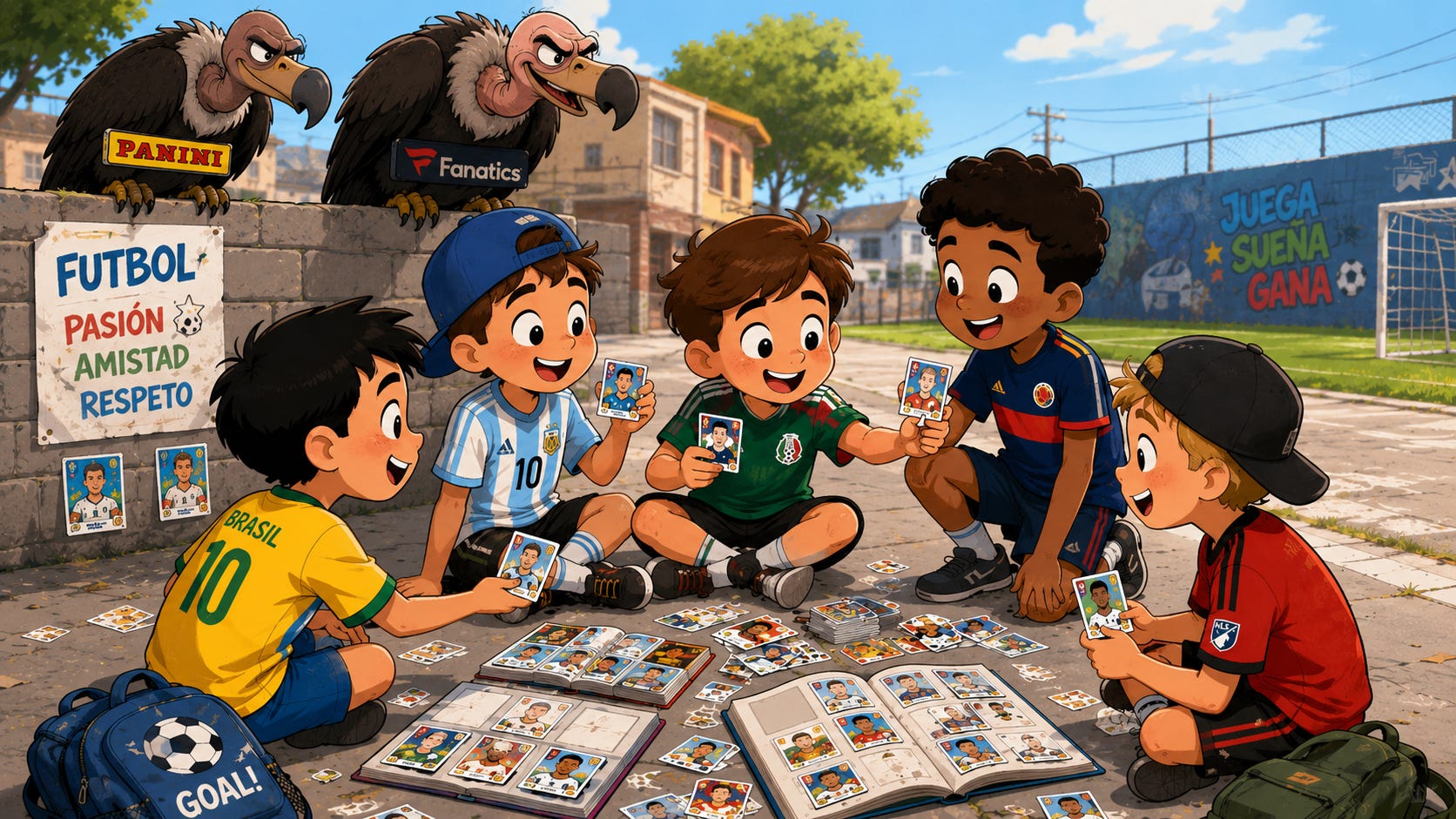
I was still in short pants when I put together my first PANINI World Cup album. I remember it like it was today: counting the minutes until my mom needed something from the corner store and sent me off to buy it, then asking if I could keep the change (where I’m from we call it la devuelta). Between every kilo of panela — those blocks of raw cane sugar — and every bottle of milk, I’d slowly fill in the little stickers of the album (in some places they call them monas, barajitas, cromos, stickers, and so on; for those of us born in Medellín, they were the “caramelos,” the candies). Now that I think about it, the leftover change never actually got me to a complete album — the things were expensive from day one. That only happened years later, when my buying power changed.
You can’t talk about the PANINI World Cup album without going straight to sensory and olfactory memory: the smell of ink, the glue smeared all over your clothes, because back then there were no self-adhesives. You stuck them down with ordinary paste, that gummy, tacky stuff we used for arts-and-crafts homework at school. The kids from a better neighborhood could afford Colbón, a PVA glue I lost track of and honestly don’t know if it still exists.
The World Cup album was always awaited with a kind of fever, the source of celebrations and of a whole underground neighborhood economy: the swap meets and the recital in front of the “dealers” going, “got it, got it, got it…” — always with a third eye open, because there was never a shortage of the bully who’d show up, slap the stack out of your hands, the famous tumbis, the snatch-and-run, and then, well, cry about it!
Maybe my whole crybaby-entrepreneur streak started right there? Who knows…
The World Cup album was more than a hobby, it was a full-blown passion, a ritual, almost a liturgy. Whoever completed the album felt like a world champion too — he was the Maradona of the block. I remember the corner stores, the parks, the school gates all filling up with “ranfañeros” (an exotic word for the guys who resold the figures), who’d work out of big boxes and make a killing, selling the scarce stickers at bitcoin prices.
Years have gone by and the World Cup album fever came back to me, making me relive the vertigo and the anxiety of chasing down the figures. I’ve had some contact with soccer schools here in the U.S., where I live, and I can tell you the World Cup fever is more alive than ever, that the album tradition has carried on from generation to generation. Just as my dad passed it to me, I see parents and kids alike making pilgrimages so they don’t get stuck without the figures of their idols. Before you assume this is an old-timers’ thing, know this: the frenzy of the PANINI collection is more alive than ever.
The Billion-Dollar Industry Behind the Stickers
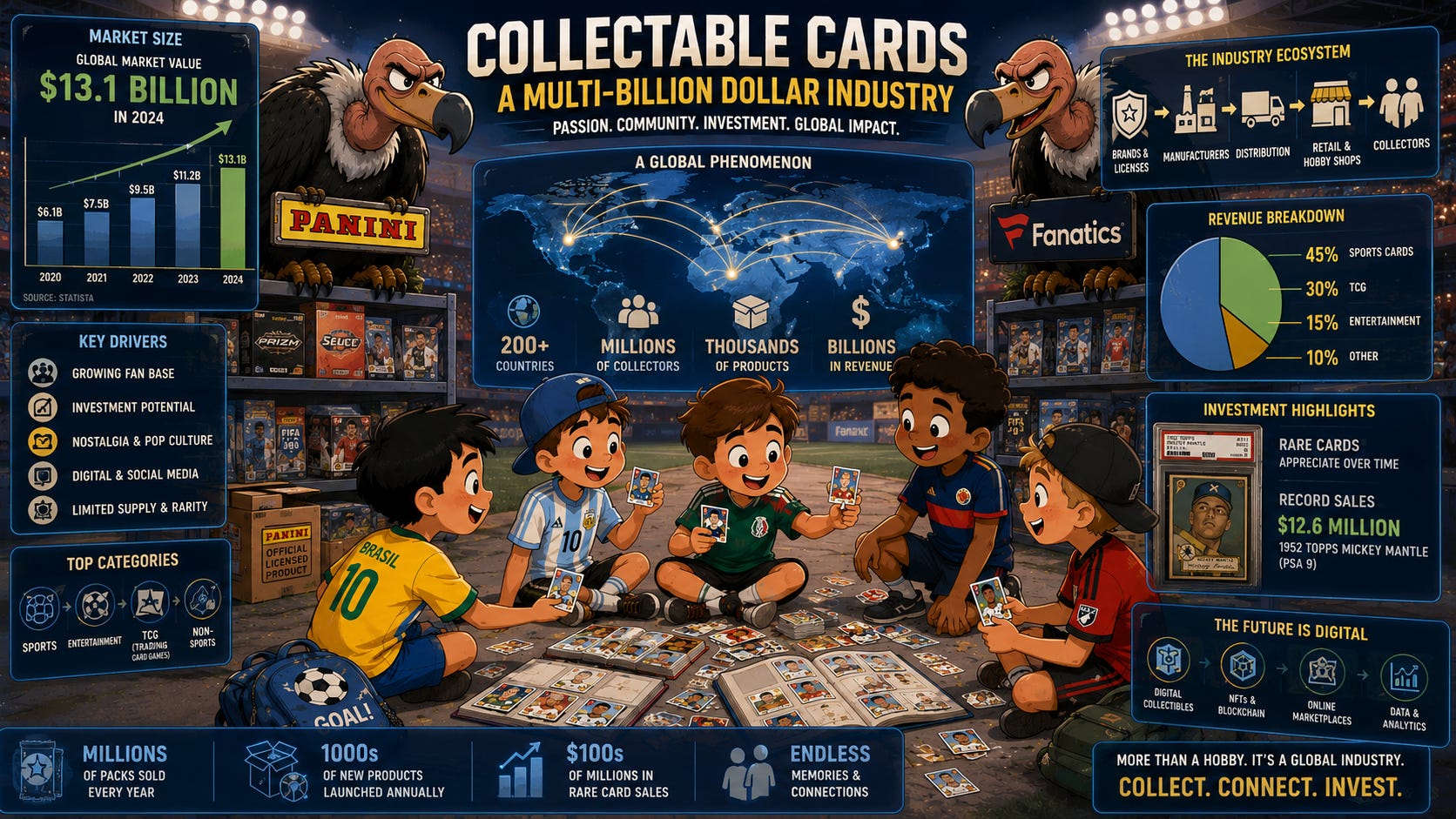
But what deals get cooked up inside the Pandora’s box that is the business of collectible figures, stickers, and cards? Let’s open that box and see how, behind a seemingly innocent business, there hides an industry with more teeth than a dogfight.
PANINI was born in 1961 in Modena, Italy, thanks to the initiative of the four Panini brothers, who started selling collectible images of Italian soccer players out of a family newsstand where they distributed newspapers. What began as a local stationery operation turned, over time, into a multinational. In 1970 the PANINI brothers signed a contract that would change their destiny forever. And they signed it with none other than FIFA, who granted them the rights to publish the first official sticker album for the 1970 Mexico World Cup.
Today, Panini S.p.A. is an Italian joint-stock company, headquartered in Modena, owned by Panini Management and Fineldo (the family holding of the Merloni dynasty, tied to Indesit). For 2024, PANINI reported profits of €1.9 billion, more than 1,000 employees, and operations organized into four divisions: Collectibles, Publishing/Comics, Panini Digital, and The Licensing Machine.
Four Ways to Print Money
1. The main engine (stickers + trading cards)
This is the economic heart of PANINI, and it runs on the following logic:
Soccer album stickers: an extremely high-volume, low-unit-cost product with excellent margins. Distributed in newsstands, supermarkets, and convenience stores across more than 150 territories. Its economics rest on “compulsive impulse”: in the U.S. a pack costs two dollars, holds 7 stickers, and completing the album takes, on average, buying 1,400 images. During World Cup peaks, the Modena factory alone produces between 8 and 10 million packs a day.
Licensed trading cards: this is PANINI’s premium product, with a higher unit value and margins that vary by segment (retail vs. hobby premium). In the U.S., Panini America (based in Texas) produces the Prizm, Optic, Select, Mosaic, National Treasures, Immaculate, and Flawless brands for the NBA and the NFL.
2. Comics and the quiet diversification
This is the least-discussed division, but strategically important. PANINI produces roughly 8,000 titles a year across comics, manga, graphic novels, and children’s books, aimed mainly at European and Latin American markets. In Italy, PANINI is the official publisher of Marvel comics and of Mickey Mouse (Disney). This gives it recurring income that doesn’t depend on the sports-events cycle, smoothing out the volatility baked into a business built around a World Cup every four years.
3. Panini Digital, the hybrid bet
This is the new battlefield PANINI has moved into, with apps like Panini Sticker Album (where users can keep a digital album running parallel to the physical one), digital trading games, and stats-capture software. Through Panini Digital, the company uses voice-activated software to capture soccer statistics, which it then sells to agents, teams, media outlets, and video-game makers. The app built for the Russia World Cup reached more than 1.5 million users.
4. The Licensing Machine, the intellectual property
Panini LM buys and resells licenses for characters and intellectual property. It acts as an agent for individuals and newspapers seeking rights to comics and celebrities. It’s a very-high-margin business, but low-volume.
Manufactured Scarcity
The CEO of Panini America, Mark Warsop, puts it this way: “manufacturing scarcity means striking a delicate balancing act between producing limited numbers of high-value cards while keeping the perceived value in every pack, so that the mom buying stickers at Walmart and the collector spending $500 at a hobby store both feel they’re getting the best for what they paid.”
That duality is the key to the whole business. A $2 pack sold to a kid at a corner store in Hialeah and a $1,500 Hobby Box sold to an adult collector in Dallas share the same production machine, the same licensing network, and the same design team. The model arbitrages between two completely different psychologies: the child’s game of trading and the adult’s investment in scarcity, using the same infrastructure for both.
The World Cup Factor
The World Cup album is PANINI’s most iconic product, and it runs on a logic of once-every-four-years peaks:
The last World Cup, in 2022, generated more than €2 billion in profits.
PANINI locked in an exclusive deal with FIFA that extends their historic partnership through 2030, giving them exclusive sticker and card rights for the 2026 World Cup, the 2027 Women’s World Cup, and the 2030 World Cup.
PANINI officially launched the 2026 World Cup album on April 28, 2026, in a ceremony at Wembley Stadium, presenting the largest collection in the Italian company’s history: 980 stickers covering 48 national teams across 112 pages.
The Operational MOAT
PANINI owns a physical distribution network across 150+ territories worldwide. Through it, the company can put its products directly into customers’ hands. That matters enormously in markets where Amazon and the big retailers aren’t the main channel — above all in Latin America, Southeast Asia, parts of Africa, and Eastern Europe. The company produces out of Modena for nearly the whole world, except in the U.S. and Latin America, where it has two factories: one in Texas and the other in Brazil.
The Disruptors
Jean-Marie Dru, founder of TBWA, used to say that the problem with the modern economy is that, somewhere in the world, in some garage, there’s a nerd with a computer trying to disrupt your business model — and that applies to PANINI to the letter.
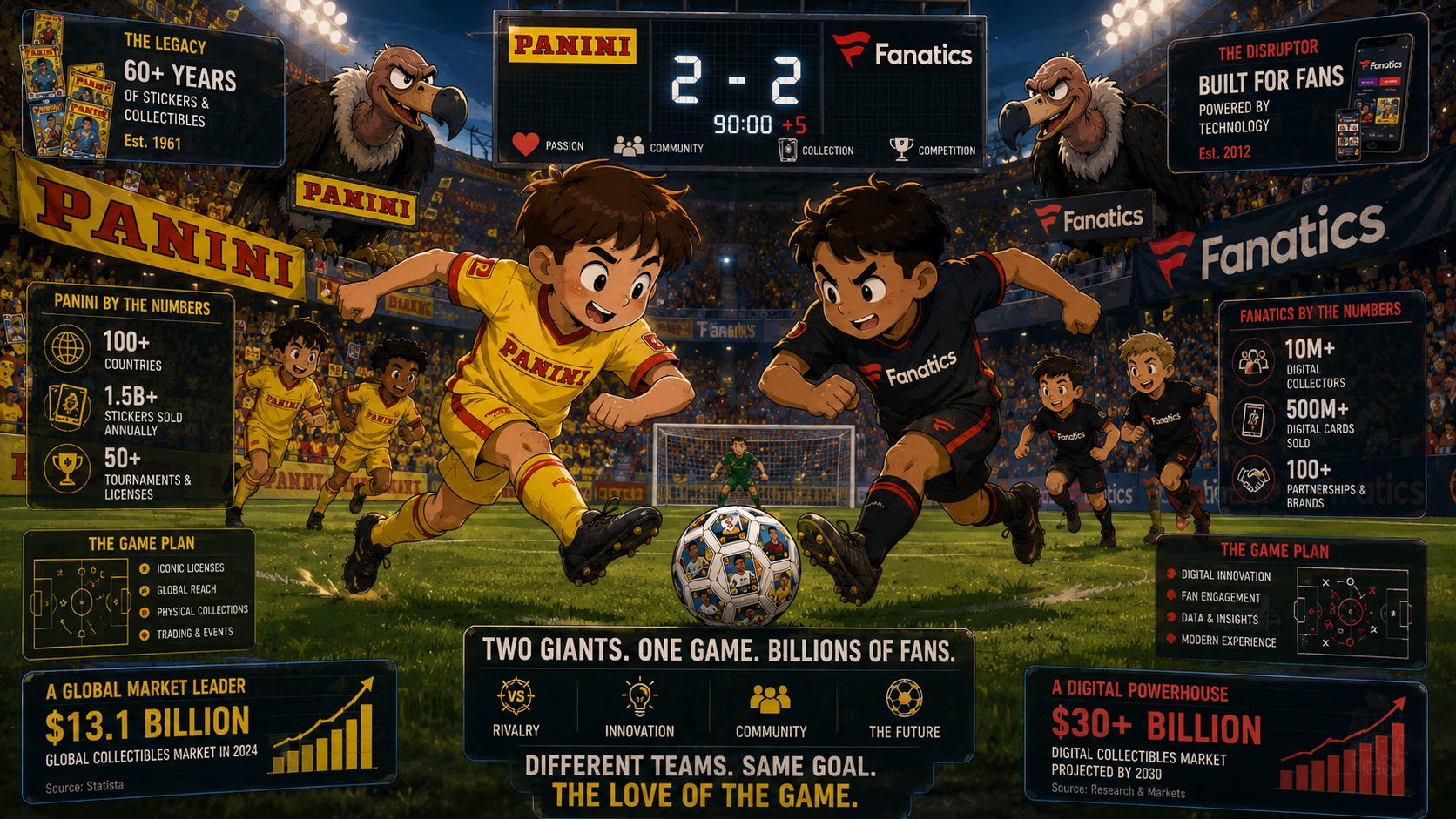
Last week, those of us who belong to the PANINI religion went cold when we heard the president of FIFA, Gianni Infantino, say at a conference that starting in 2030 PANINI will no longer make the World Cup album, and that from that year on, our album as we know it will disappear and be handed to the multinational FANATICS. If the news landed on us collectors of nostalgia like a bucket of ice water, imagine how things must be inside PANINI.
This news isn’t new, even though it was only just announced at Infantino’s conference. The idea that PANINI was on the ropes had already been simmering deep inside FIFA. On top of that, there’s a years-long legal war between PANINI and Fanatics. Seen this way, the intrigue is running on three fronts at once: the loss of PANINI’s American licenses, the legal litigation, and the possible sale of the company.
The Lost Licenses
PANINI built its dominance of the North American market in 2009 with a brilliant move. Taking advantage of the fact that the NBA had canceled its contracts with Topps and Upper Deck — and even though both companies had expressed interest in continuing to print basketball cards — PANINI saw that both rivals were undercapitalized, seized the opening, and came to the negotiating table with cash in hand, which ultimately left those two competitors out of the game. In under three years, PANINI became the second-largest producer of sports cards in the world.
There’s a brutal strategic lesson here: more often than not, the big opportunities show up when the giants are going through liquidity problems. PANINI didn’t win on vision alone; it won because it arrived at the right moment with the capacity to execute and capital on hand. In fiercely competitive industries, timing can matter more than the product itself.
In January 2022, Fanatics bought Topps and proceeded to offer the leagues a far bolder move to get PANINI out of the way. This time it didn’t just put more money on the table — it also offered them equity in the business, leaving PANINI practically shut out of the United States market. In short, it paid PANINI back in the same coin PANINI had used in 2009.
The fascinating thing about this play is that the battle stopped being a simple licensing negotiation and became a war of vertical integration. Fanatics understood that making products wasn’t enough; you had to control the entire ecosystem: licenses, athletes, distribution, digital platforms, breakers, events, and user experience — and that changed the board completely.
This is the timeline of Panini’s fall:
August 2021: Fanatics announces exclusive deals with MLB/MLBPA (starting in 2026), NBA/NBPA, and NFLPA for the future.
October 2025: Fanatics/Topps officially takes control of the NBA licenses.
April 2026: Topps, owned by Fanatics, becomes the exclusive licensee for NFL cards.
After April 2026, Fanatics will hold exclusive licenses for the NBA, NFL, MLB, Premier League, F1, and WWE.
For Panini America, this means its NBA and NFL product lines — which carried much of its growth for 15 years — will now vanish.
And this is where the real problem surfaces: when a company leans too hard on outside licenses, it never really controls its own destiny. You can have the best design, the best manufacturing, and the best distribution, but if another player shows up with more capital and better financial incentives, the whole castle can start crumbling in a matter of months. This is a lesson I’ve lived in my own skin, which is why, whenever I’m about to invest in any new business, I always ask myself: on which side is the handle of the pan?
The Legal War
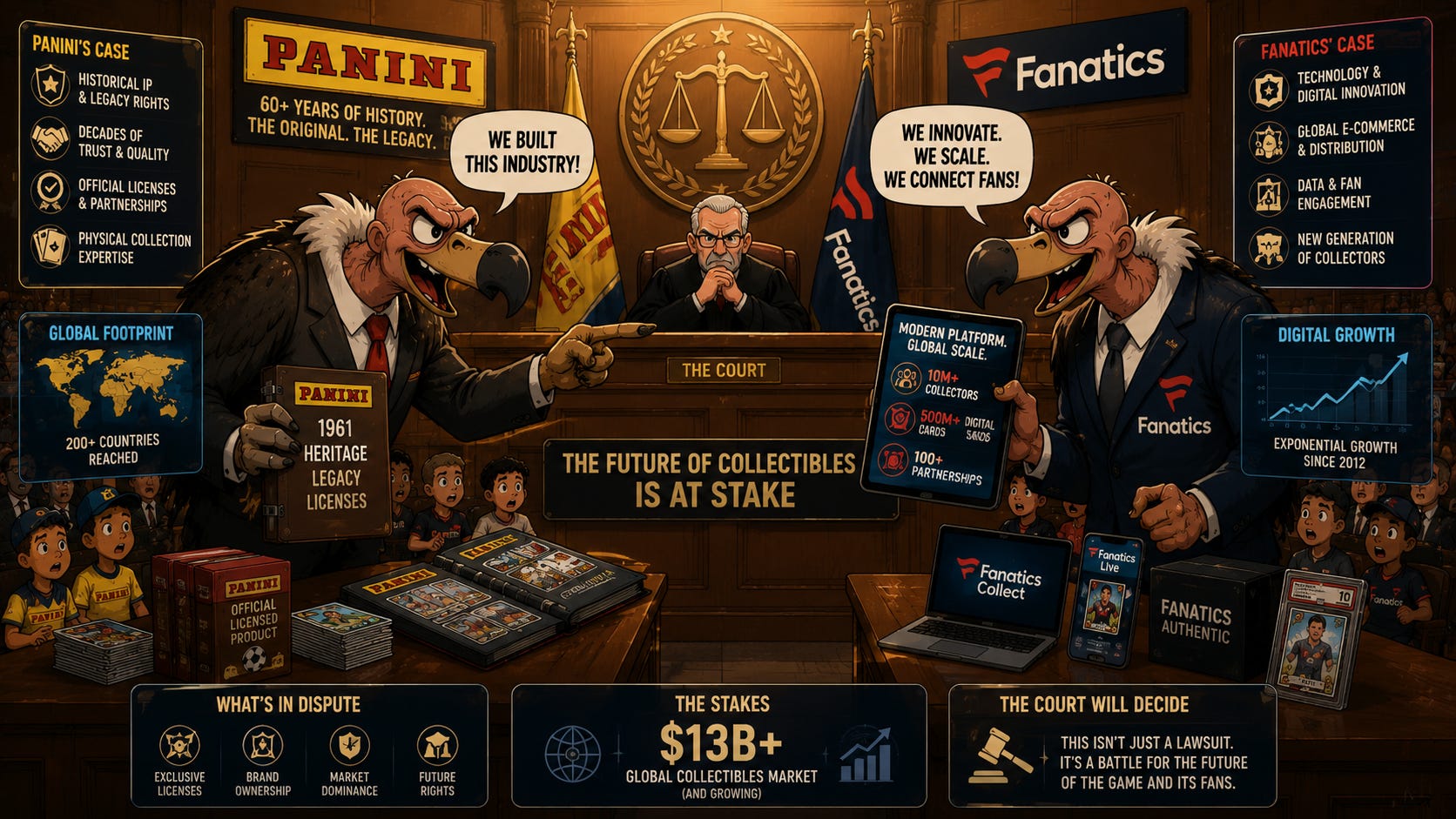
PANINI hasn’t rolled over quietly. In August 2023, PANINI filed a lawsuit against Fanatics. The core of the legal argument is that Fanatics conspired with the leagues to create an openly illegal monopoly.
The judge on the case stated in her report that “there was a conspiracy among the NFLPA, the MLBPA, and Fanatics to license the intellectual property of both players’ associations exclusively.”
She likewise held that PANINI had “adequately alleged the facts” supporting its claim that Fanatics enjoys “monopoly power” because it can set prices and shut out competitors as it pleases.
This judge’s ruling will let PANINI pursue antitrust liability, including a possible injunction “against implementation of the long-term exclusive agreements” to produce and market trading cards. But in no scenario will it get the licenses back.
The fight for control of the sticker market seems to run much deeper than we imagined. It looks more like a geopolitical battle than a market dispute.
It’s said that Fanatics allegedly bought the print shop PANINI used to make its products and, with it, slowed PANINI’s production down.
PANINI accuses Fanatics of threatening to blacklist its employees so they could never work in the industry again, unless they quit immediately and joined Fanatics.
The legal battle also details how Fanatics allegedly leveraged its monopoly power to coerce distributors, retailers, and local card shops into accepting higher prices and restrictive terms, while raiding PANINI’s staff and pressuring star athletes to sign exclusive autograph deals.
Fanatics also filed a countersuit alleging that PANINI used abusive employment practices to keep its ex-employees from joining Fanatics. The company denied the claims and fired back, accusing its competitor of launching a “prolonged, unlawful, and deceptive campaign of unfair business practices, pressure tactics, and unfair competition,” in an attempt to force Fanatics to pay a giant sum so that PANINI would terminate its licenses early in 2022.
From here on, this FUTOPIX stops being about stickers. Because what we’re really watching is a modern war for control of cultural ecosystems. Licenses, platforms, manufacturing, talent, athletes, distribution channels, and intellectual property are all being absorbed into a logic of brutal consolidation where the winner isn’t trying to compete: it’s trying to centralize power and seize total control of an industry with practically no competitors left.
Even though PANINI could win a great deal of money in damages, the pursuit of a remedy — when monetary damages aren’t enough — likely won’t be granted, according to lawyers who specialize in this kind of business.
In other words: Panini will probably get a check, but again, it won’t get the licenses back.
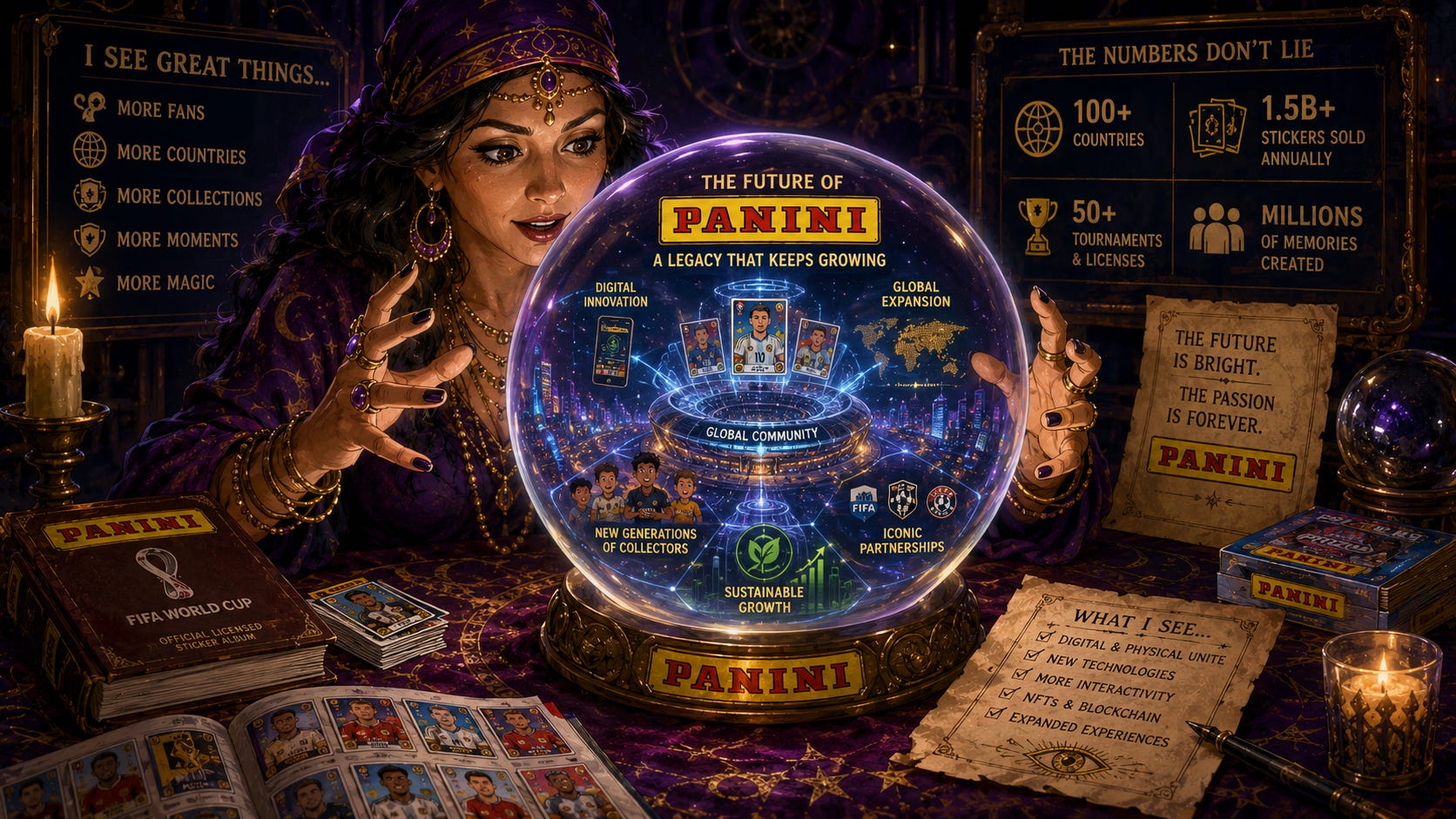
What’s Next for PANINI
This is the most recent twist, and maybe the most decisive. PANINI is exploring strategic options, including a possible sale. Citi Bank has been picked as financial advisor to Panini Group to evaluate the process. PANINI’s strategic review follows close on the heels of the death of CEO Aldo Hugo Sallustro in April 2024, who led PANINI for more than 30 years while overseeing the company’s expansion into the United States.
Speculation points to global investors like Advent, Charterhouse, and CVC as potential buyers. And here’s where the truly important subtext appears.
The death of the longtime CEO automatically set off the succession conversation. Sallustro had sustained the company’s Italo-Argentine culture for three decades. His death leaves a vacuum of strategic vision at the worst possible moment: loss of American licenses, competitive pressure, and structural transformation of the industry.
The most natural buyer would be Fanatics, which would fully consolidate the sports-collectibles sector under a single roof: Topps + Panini. That would mark the formal close of the historic duopoly that dominated the industry for decades.
But the timing doesn’t look accidental. The 2026 World Cup will probably be an extraordinary year for PANINI. The company could once again top €2 billion, driven by the event alone. That maximizes the asset’s valuation, brutally, ahead of any possible acquisition. The sale rumors landing right before the World Cup aren’t a coincidence — they’re the peak of the company’s narrative and financial value. Meanwhile the fight for control of the market and the talent in this industry will grind on.
Fanatics has hired several PANINI staffers, and PANINI has tried to block the exodus. This matters far more than it seems, because the manufacturing, design, and card secondary market know-how isn’t trivial. PANINI built two decades of expertise in the U.S.: designers, parallels specialists, autograph procurement experts, and athlete relationships.
If Fanatics manages to extract that talent, it doesn’t just win the licenses — it also wins the operational capacity to execute them. Without that talent, the licenses would be just paper, and there lies one of the great secrets of the creative industries: companies don’t compete only for customers or contracts; they compete for accumulated knowledge.

The Last Sticker
Maybe this story was never really about the figures. It was never only about printed stickers, foil packs, or soccer. Deep down, it was always talking about us. About the kids who ran to the newsstand with sweaty coins in their pockets, about the endless afternoons swapping stickers on the sidewalks, about the anxiety of tearing open a pack hoping the hard one would finally show up, and about that small collective ritual that managed to connect entire generations long before social media existed. Because while today’s tech world talks obsessively about engagement, communities, and immersive experiences, PANINI had been doing exactly that for decades out of an Italian stationery shop. Maybe that’s one of the most beautiful ironies in this whole story: one of the most successful social platforms on the planet never needed the internet to exist. It ran in parks, schools, corner stores, recess yards, and dining tables — it ran wherever we humans interacted.
That’s why PANINI’s real asset was never the licenses, nor the printing machines, nor even the premium trading cards worth hundreds or thousands of dollars. The real asset was something much harder to build and, above all, much harder to buy: the collective emotional memory of several generations. That explains why the Fanatics-PANINI story leaves so many collectors with a strange feeling. Because although, financially, the market logic looks obvious, culturally it feels as if someone were trying to buy a piece of childhood. But childhoods don’t work like licenses. Licenses get signed, renegotiated, sold, and lost. Cultural rituals survive far longer; nobody can acquire, through a bank transfer, what took decades to build inside the emotional memory of millions of people.
Fanatics can end up with contracts, athletes, platforms, and entire markets, but there’s something it probably will never fully be able to buy: the feeling of walking into a corner store and finding, for the first time, the World Cup album sitting on the counter. That moment belongs to another place, another speed, another kind of economy. An economy where there was still room for wonder, where time seemed slower, and where a kid could spend whole weeks thinking about a single hard-to-get sticker. Because back then the figures weren’t competing against thousands of simultaneous stimuli; they were the very center of the conversation. The album traveled tucked under your arm like a badge of identity, and every completed page felt like a small personal victory. Completing a World Cup was also a way of growing up.
Maybe that’s why this possible ending feels so symbolic. Because deep down, the story of PANINI is also the story of a much larger generational transition: the shift from a capitalism built on physical rituals and collective memory toward one dominated by platforms, consolidation, and algorithmic control of consumption. Before, we collected in order to trade; today many collect in order to speculate. Before, the figures passed through the hands of children; today some end up encased in vaults as financial assets. Before, the album was an excuse to get together; today it often ends up turned into content for social media. And yet, against all logic, I’ve witnessed that the ritual is still alive. Kids still open packs, parents still help stick down the stickers, schools still fill up with improvised swap sessions, and millions of people still feel that little hit of dopamine when a hard-to-get figure finally appears.
That should tell us something enormous about human nature. Because in an ever more digital, automated, and synthetic world, we still need physical objects that connect us emotionally with others. We still need symbols, rituals, and shared stories. And there, probably, is the great strategic — and also deeply human — lesson of this whole story: competitive advantages based solely on exclusive contracts are far more fragile than they look, while advantages built on collective memory, nostalgia, generational rituals, and shared culture can survive even when the companies, the owners, and the rules of the market change.
Because in the end, the figures were never just figures. They were tiny time capsules. Small emotional archives of who we once were. Maybe someday, when our children or grandchildren find one of those forgotten albums inside an old box, they’ll open it slowly again, smell the aged paper, and instantly understand something no digital platform will ever fully replicate:
There was a time when the whole world fit inside the World Cup album — honestly, what an extraordinary era we got to live through!

Thanks for reading and sharing!
GabrielBedoya.com
DISCLAIMER
This document is for informational, educational, and futurist-analysis purposes only. It does not constitute financial advice, an investment solicitation, or a recommendation to buy, sell, or participate in any instrument, company, project, or asset.
If anyone uses the content of this material to solicit money, investments, or economic participation, treat it immediately as a possible scam.
Always protect your personal and financial information.
🔮 Keep exploring FUTOPIX
The War of Symbols: How Brands, Memes, and Politicians Hack Your Mind