


A couple of years ago I heard Hernán Jaramillo, founder of 10 AM, talking about Palantir. At first I barely paid attention; I figured the stock market wasn’t for me, I saw it as a thing for old-timers sipping coffee at the Bar Ganadero downtown in Medellín. Besides, I was deep in the weeds mining Bitcoin (BTC), and anything that wasn’t BTC struck me as a waste of time.
I remember it well: back then Palantir shares were trading somewhere between 16 and 20 dollars, a world away from the price of BTC. To my surprise, weeks later I started watching Palantir grow and grow like foam. While that was happening, I watched the members of the 10 AM chat buy Tesla as if the shares were going to run out tomorrow. It was only when I saw Solana climb after the FTX disaster — rising from $6 to $20, $40, and on up to prices that had seemed unthinkable — that I finally started to wise up.
With that scene playing out in the background, I began to ask myself: how do they do it? What do they see that I don’t? What do the people at 10 AM have that lets them read which stocks or cryptos will grow over time until they hit returns of 10X or more?
At the time it felt paradoxical. I make my living from futurism (foresight), and I found myself questioning it hard, because the “future” is the field of knowledge that puts food on my table. It seems only logical that, if I spend my days spotting emerging signals, I should know how these characters figure out where to put their money and pull off incredible returns.
For this and other reasons I wanted to get a closer look at how the minds of my conversation partners actually work, so I set myself the task of going a little deeper into the craft of learning to read the signals.
Futurism has long been thought of as the disciplined application of resources toward clearly defined goals under conditions of relative stability. Yet in an era defined by accelerating technological change, shifting consumer behavior, and systemic uncertainty, the traditional model is simply not enough. The future no longer arrives as a linear extension of the past; on the contrary, it emerges discontinuously, often out of phenomena that at first look insignificant, fragmented, even irrelevant.
These early, invisible, ambiguous, and usually unnoticed manifestations of change are what some experts call “Weak Signals.” Please don’t get confused: weak signals are not trends, they are not fully formed or consolidated opportunities or threats. On the contrary, they are the precursors of transformation, the earliest detectable indicators of systemic variation, hiding under the structural rug of markets, technology, and society.
In this FUTOPIX we’ll explore the concept of “Weak Signals” in a little more depth, to place it squarely within the field of strategy. That’s why it matters to understand that weak signals are not a peripheral capability but a core function of the strategist; once you learn to spot and develop them, they become a source for decision-making and for building competitive advantage.
The Nature of Weak Signals
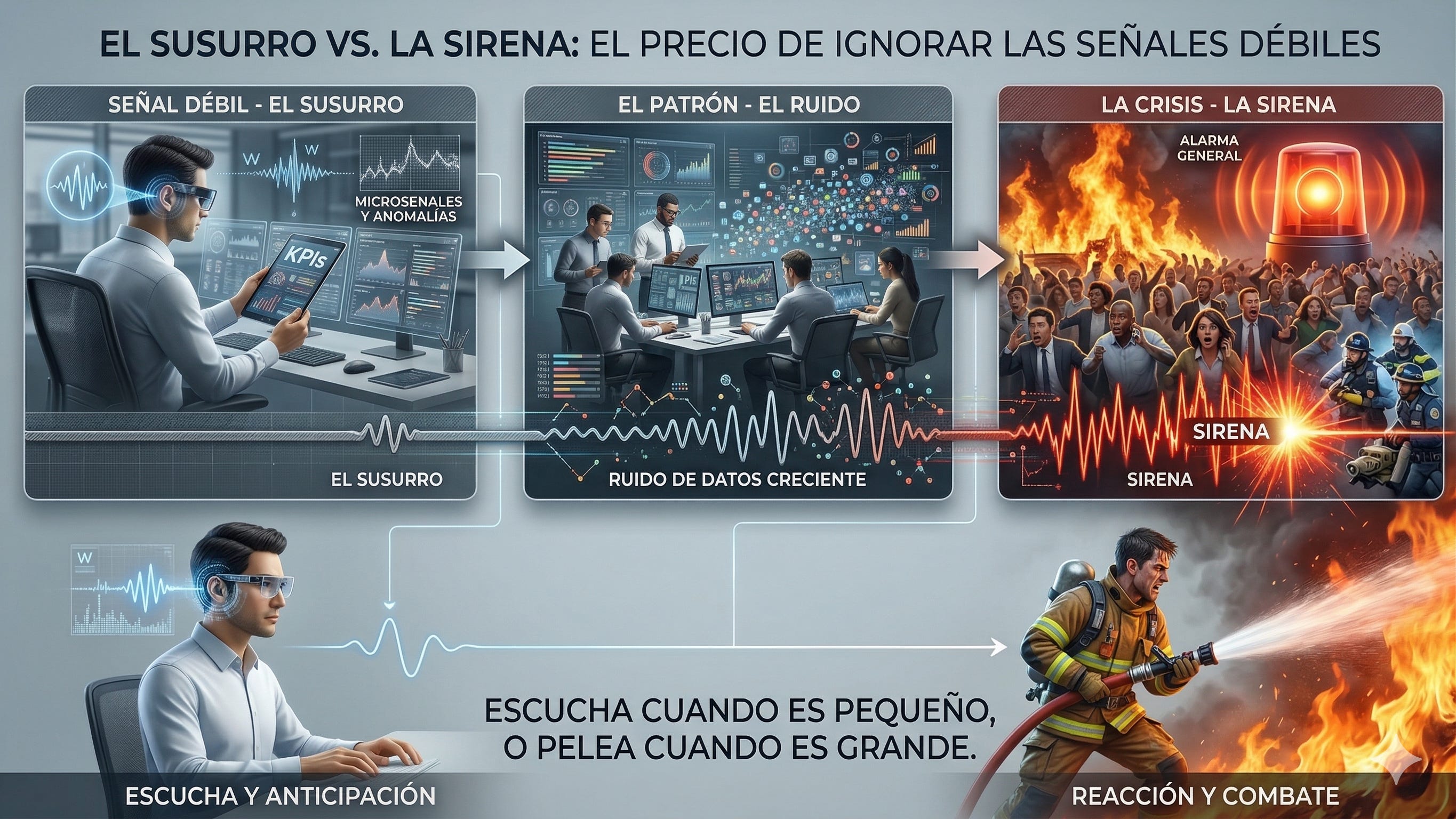
Weak signals can be defined as early, low-intensity indicators of developments with significant potential to change the future. They are marked by their ambiguity, their lack of clear interpretation, and their appearance at the margins of the system, well before they surface at its center. Unlike trends — which are visible, measurable, and widely known — weak signals exist in a state of pre-consensus. They have not been validated by large-scale data, nor are they backed by a dominant narrative.
Their position in the life cycle of change is critical. Transformations rarely emerge fully formed. Instead, they evolve in stages. At first, signals show up as isolated anomalies, unexpected consumer behaviors, applications at the bleeding edge of technology, or niche cultural shifts.
For example, years ago the growing use of apps like Musical.ly (which later became TikTok) looked like teenagers goofing around lip-syncing to songs; for the average person it was just irrelevant noise. Take another case: the first experiments with plant-based proteins in food niches around 2015 looked like a marginal fad, but they were announcing the massive transformation of the food industry. In crypto, the resurgence of Solana right after the collapse of FTX — when few people trusted any alternative to Ethereum — was a weak signal that many of us ignored.
Weak signals are something like the foam on a beer: they keep rising as the patterns that form them gain coherence, evolving until they turn into trends that will eventually reconfigure industries and write new rules for the market. The strategic implication is clear: by the time a trend is widely recognized, the window to gain an edge has already closed.
Weak signals, therefore, occupy the most valuable and most challenging stage of this progression.
The Strategic Importance of Weak Signals
The importance of weak signals lies not in their predictive precision but in their power to expand the range of strategic possibilities. Traditionally, strategic planning tries to reduce uncertainty by forecasting outcomes and committing resources accordingly. Weak signals, by contrast, embrace uncertainty as a source of opportunity. They let us identify emerging possibilities before they take definite shape, and in doing so, create options instead of commitments. It’s precisely this shift in logic — from reducing uncertainty to operating within it — that redefines the very nature of strategy.
In high-uncertainty environments, the strategic goal stops being prediction and becomes positioning. When we lean only on established data and validated trends, we’re effectively competing in a known game, where advantages are incremental and often fleeting. But when we decide to operate on weak signals, we enter a different territory, one where the edge doesn’t come from executing better, but from seeing sooner. That’s where we gain access to “privileged insights,” born from understanding emerging dynamics that haven’t yet been shared or widely broadcast.
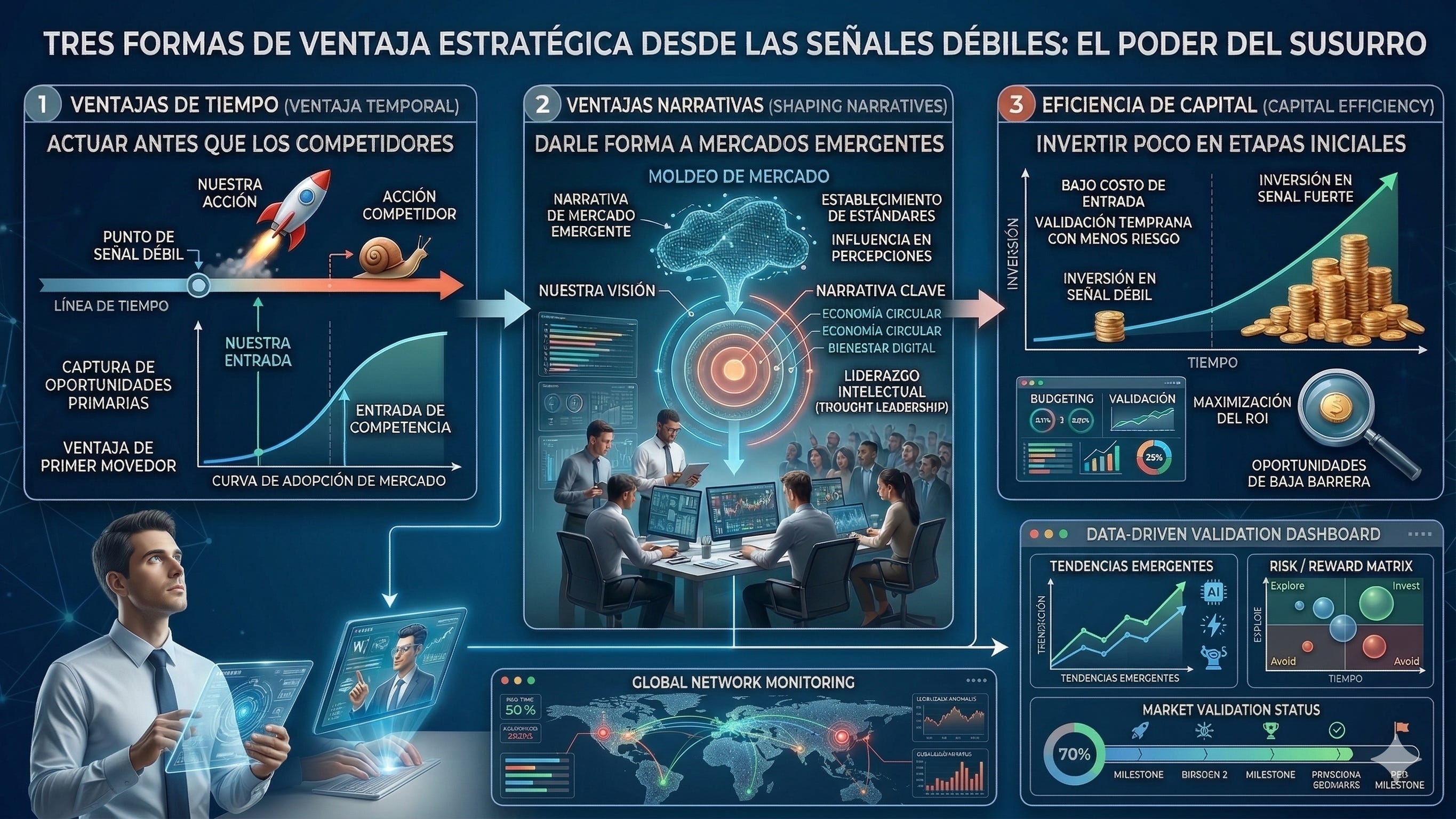
Such insights aren’t abstract; they translate into concrete advantages within the strategic game. From that anticipatory reading of the system, we unlock three forms of advantage: timing advantages, by acting before others (like the people who bought Palantir or Tesla early); narrative advantages, by shaping emerging markets before any consensus exists; and capital efficiencies, by investing little in the early stages through controlled experimentation rather than late, expensive commitments.
Despite the importance of these signals and the advantages they unlock, we have to admit that, as strategists, we sometimes fail to detect them and, above all, to act on them. Here is the central tension of the problem: understanding the value of weak signals doesn’t necessarily mean knowing how to operate them. These failures aren’t incidental; they’re rooted in our mental architecture, in the way we process information, and in the cultural frames from which we make decisions. The good news is that these aren’t fixed limitations but trainable capabilities, and so they can be reshaped if we approach them with intention (this is what some people at 10 AM do very well).
Cognitively, we tend to operate under a bias toward certainty. Our decision-making processes prioritize data that is measurable, validated, and aligned with existing models, because that reduces perceived risk. This is exactly where the friction with weak signals arises, because they, by definition, meet none of those criteria. They emerge in uncertainty, they live in the territory of the anecdotal, and they’re hard to quantify. Precisely for that reason, our minds discard them easily — not because they lack value, but because they don’t fit the filters we’ve been trained to make decisions with.
Structurally, this cognitive limitation gets amplified. We tend to organize information into compartments, creating mental silos that limit our ability to connect scattered signals. What we fail to integrate, we cannot interpret, and what we don’t interpret, we cannot act on. What shows up as isolated noise rarely becomes a pattern unless there’s a conscious effort to integrate it.
Culturally, on top of that, we tend to reward execution over exploration. We value whatever produces immediate, measurable, defensible results, while the uncertain, the emerging, and the unvalidated gets pushed aside. The result is a structural operational blindness: we optimize the present while making the future invisible.
From Detection to Action
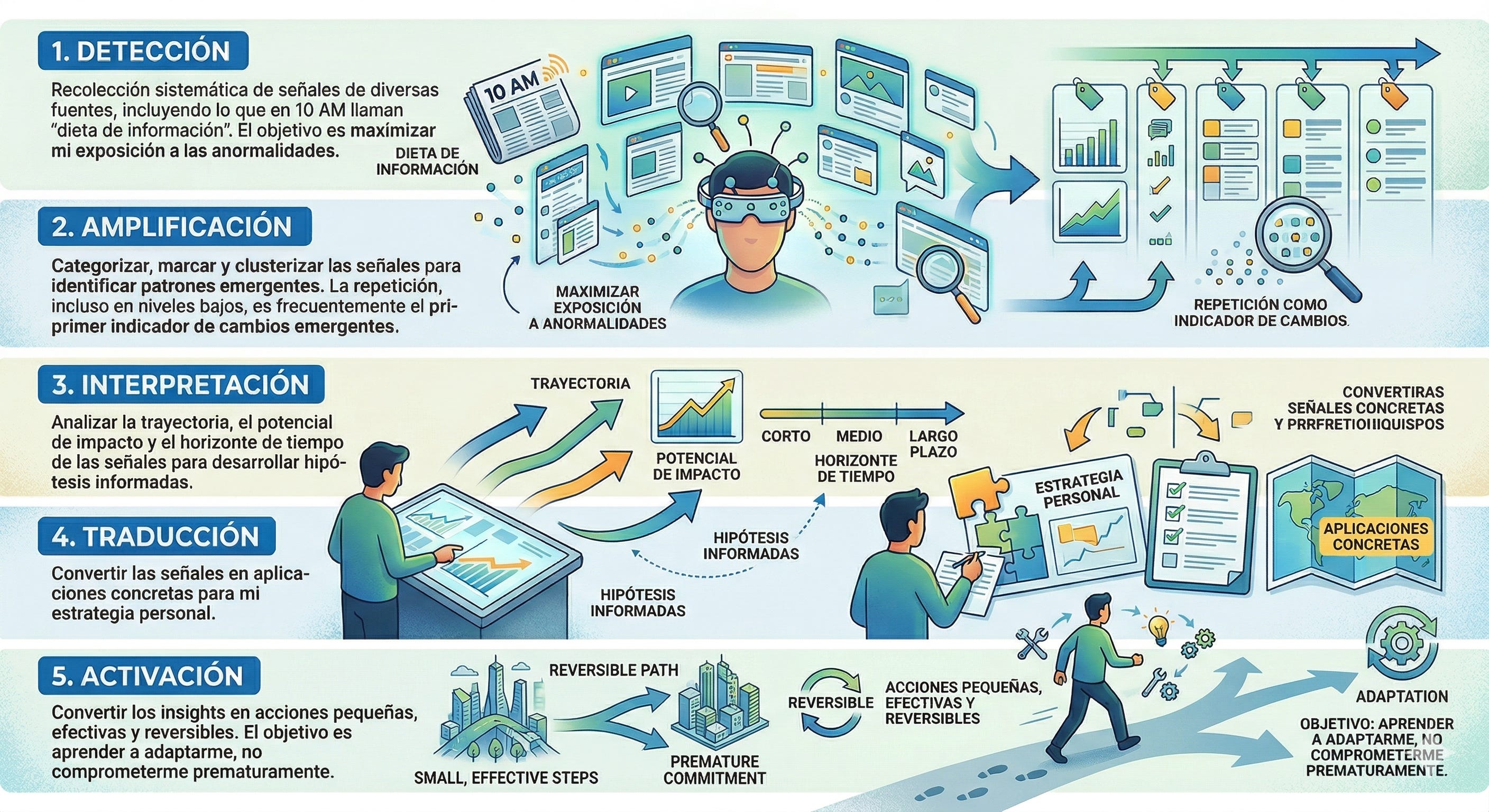
To meet these challenges, as strategists we have to develop systematic approaches that let us detect and act on weak signals. The following framework has five interconnected stages: detection, amplification, interpretation, translation, and activation.
Detection: This is the systematic gathering of signals from a range of sources — what Hernán Jaramillo calls an “information diet.” The goal is to maximize our exposure to the market’s anomalies.
Amplification: We categorize, tag, and cluster the signals in order to spot emerging patterns. In anthropology we call this “recurrence,” and recurrence — even at low levels — is often the first indicator of emerging change in the system.
Interpretation: This is analyzing the trajectory, the potential impact, and the time horizon of the weak signals in order to build informed hypotheses from them.
Translation: This is about turning weak signals into concrete actions for our own personal strategy.
Activation: We turn the insights into small, effective, reversible actions. The goal is to learn to adapt, not to commit prematurely.
Operationalizing Weak Signals
For weak signals to become a personal skill, we have to build them into our way of life instead of treating them as occasional initiatives. That requires dedicated structures, processes, and concrete practices woven into our daily routine.
It’s worth keeping in mind that to enter signal-hunter mode, you have to switch on the mental habits your mind needs to detect and act on weak signals. These mental habits should run with a certain degree of autonomy, free from the immediate pressure of hitting metrics, and they should draw on diverse perspectives — from strategic thinking to technological affinity to reading the context.
Regularly reviewing the information we consume is essential to keep the momentum and make sure the signals surface; the art of detecting weak signals is above all a process of watching your environment. Unlike traditional strategic planning cycles (annual or quarterly), weak signals demand higher-frequency monitoring: weekly or biweekly reviews to catch shifts and respond dynamically according to our interests.
We have to reward curiosity, experimentation, and the generation of insights as the engines of this process, even knowing that signals often come from uncertain terrain. Without that internal backing, it’s impossible to engage in detection at all, because we’ll perceive it as risky and unproductive.
Personal leadership plays a critical role here: we ourselves have to actively support and legitimize the exploration of weak signals. Becoming a signal hunter is a strategic asset.

The Payoff
When we truly develop the ability to read weak signals, we stop reacting to trends and become someone able to anticipate the system’s moves before they become obvious. But what really changes isn’t just our position in the market — it’s the way we inhabit reality. We stop depending on consensus, we stop waiting for validation, we stop moving only once everyone else has already arrived. We start operating in a different territory, a territory where the future doesn’t yet have a name, but already has a direction.
That’s where a difference appears that is anything but minor: not everyone in the system is playing the same game. Most people observe, confirm, and execute; a few detect, interpret, and act. The first group optimizes what already exists, the second takes part in building what’s emerging. Some arrive safe, others arrive early.
In today’s economy — defined by speed, information overload, and constant disruption — the ability to hunt weak signals stops being an intellectual curiosity and becomes a critical competency. It’s no longer enough to be informed, no longer enough to understand trends, no longer enough to execute well. What makes the difference is the ability to see sooner, to hold ambiguity without collapsing, and to act without any guarantee.
Because there’s an uncomfortable truth here that few are willing to accept: the future doesn’t reward whoever understands first, it rewards whoever moves first. Moving first means discomfort, it means doubt, it means exposing yourself without a net. It means operating without the backing of consensus, without clear metrics, without an established narrative. It means thinking and acting like a strategist, not like a follower.
This is where the skill of hunting weak signals stops being optional. Not knowing how to read those signals in this environment isn’t a technical limitation, it’s a systemic vulnerability. It’s being trapped in cycles of reaction, depending on late decisions, competing in spaces where the advantage has already been captured by someone else. In other words, it’s always playing from behind — and from back there, it’s hard to reach 10X returns.
See Before You Act
Finally, I’d like to say that strategizing isn’t simply choosing where to compete, it’s understanding the evolving landscape in which we make decisions before that landscape is obvious to everyone. Weak signals are the earliest and most fragile expression of that system in transformation. They’re incomplete, ambiguous, often uncomfortable — but that’s precisely why they hold the greatest potential for advantage. Learning to detect them and, above all, to act on them is moving from reaction toward anticipation, it’s training a sensitivity that doesn’t rest on certainty, but on attention.
Because seeing weak signals isn’t a technical act, it’s an act of perceptual discipline. It’s consciously deciding to observe what others discard, to connect what looks unconnected, and to hold what doesn’t yet have form. It’s training the eye until the noise begins to reveal the structure.
In the end, our job as strategists isn’t to respond to change, it’s to recognize it before it becomes obvious, and — more importantly still — to act while there isn’t yet enough evidence to justify acting. Because in that space, between what is barely emerging and what has yet to be validated, is where real advantages are built; this is the space where the 10X gets made.
Weak signals don’t arrive as certainties, they arrive as discomfort, as a persistent hunch, as patterns that don’t quite fit. They are the future in its rawest, quietest, and easiest-to-ignore state. For that very reason, they’re the terrain where the ones who follow are separated from the ones who lead, which is why they cost us so much. We often think we’re the ones leading, but reality sometimes shows us that we’re only followers — that someone else is the one carrying the lamp that opens the path.
The invitation isn’t to understand weak signals, it’s to train them. Not to study them, but to practice them. Start observing differently, start questioning the obvious, start paying attention to what doesn’t fit; open your eyes to spot the nerd tinkering in a garage, the one playing with AI, the one who can read a whole industry — because that’s where something is changing.
In an economy like today’s, where time compresses and advantage is captured early, the difference between those who survive, those who compete, and those who build the future isn’t in the quantity of information they consume, but in its quality and their ability to read what hasn’t been explained yet.
Hunting weak signals isn’t an advantage, it’s a way of thinking, it’s a discipline, and increasingly, it’s a skill of economic supremacy.

DISCLAIMER
This document is intended solely for informational, educational, and futures-analysis purposes. It does not constitute financial advice, an investment solicitation, or a recommendation to buy, sell, or participate in any instrument, company, project, or asset.
If anyone uses the content of this material to solicit money, investments, or financial participation, treat it immediately as a possible scam.
Always protect your personal and financial information.