

When Artemis Went to Fetch the Moon!
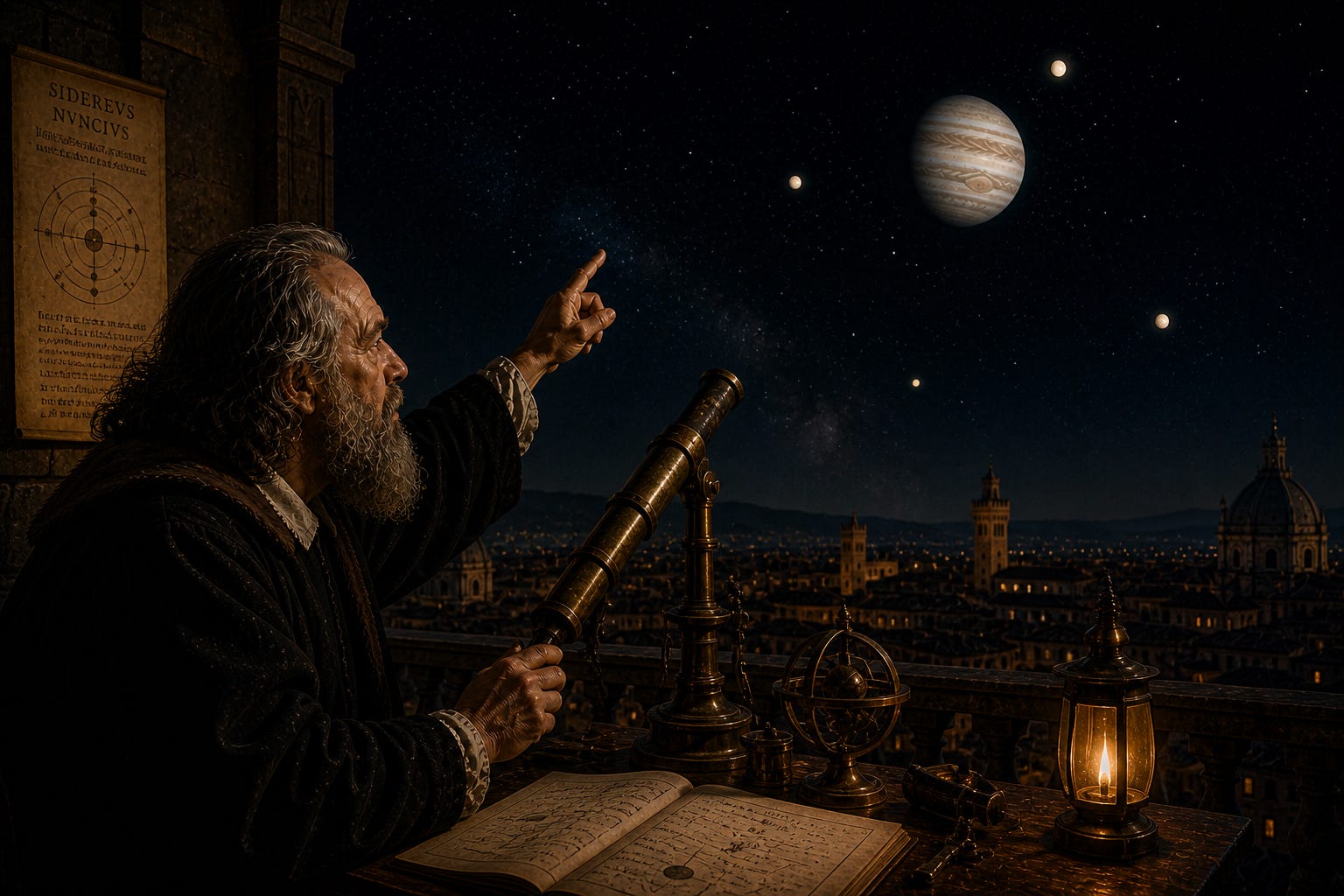
On a night in early January of 1610, an aging mathematics professor in the city of Padua — a man whose academic passions were mostly a way to dodge his enormous debts, the demands of his three children born out of wedlock, and a job that bored him to the marrow — sat in the dark corners of his study. There he hunched over a tube of leather and brass and pointed it at the sky. Honestly, you couldn’t call the thing a telescope; it was more of a jury-rigged, home-made astronomy kit, and with it the old professor probed his own curiosity and the edges of the night sky.
That night, to his deep surprise, he found three points of light lined up beside Jupiter. In his field journal he jotted them down as “new stars.” Four nights later he scanned the sky again, and this time there were four — but the truly astonishing part was that they moved, which left him chewing on why they’d behave so strangely, so unlike other heavenly bodies. Only by January 13th, after a great deal of head-scratching, did he grasp that they weren’t stars at all. They were celestial bodies orbiting something that was not the Earth. The discovery blew his mind: the Earth was not the center of anything! It’s just another rock in space, spinning around something else...
Galileo did not discover the moons of Jupiter; he simply saw them move. That sighting would change his life and his fate forever, for better and for worse. The professor’s real discovery came only afterward, when he set about convincing everyone else that what his “telescope” was showing up in the heavens was truer than what Aristotle had written down many centuries before him. It took the Church one hundred and twenty years to accept what a fifteen-ducat tube had already proven — one hundred and twenty years of inertia and threats, hundreds of generations raised on the idea of a universe that did not exist.
I’m writing these notes in May of 2026, after two much-needed weeks off, to tell you that a North American company — from the state of Iowa, no less — signed a contract with the Department of Energy to extract lunar dust, to be paid at twenty-five million dollars a kilogram. All of this is happening in a world where there are already machines that write better than almost every copywriter on your LinkedIn feed, where agentic artificial intelligence just turned the technical barrier to founding a company into a weekend errand, where supply chains are being re-nationalized in real time — and where we, the ones who claim to “design the future,” keep raising our kids for an Earth that is the center of nothing, arguing, with ridiculous seriousness, over whether to move to Lisbon, whether to pick up a second passport, or whether whining about the swamp of regulations makes us entrepreneurs or just crybabies.
That’s the question of this FUTOPIX. I don’t know which technologies are coming — that barely matters anymore; technology is like taxes, it always shows up. After the recent spectacle of the NASA | Artemis mission, the question is: under which of the four moons are we raising — maybe without ever deciding to — the generation that will replace us?
Galileo christened his four moons with an embarrassingly courtly name: the “Medicean Stars,” in honor of his patrons. But the worst of it was that the Church silenced him; he had to swallow his own discovery on pain of being fried alive. Later, other astronomers — Kepler, Marius — ended up rechristening them with the names we know today: Io, Europa, Ganymede, Callisto. Justice would have been served if at least one of them had been named Galileo. Four figures from Greek mythology, four lovers whom Jupiter seduced, abducted, or transformed.
Let’s sit with this for a second. The four moons that split Western cosmology in two are, mythologically, four victims of a god who wanted them for himself. This isn’t a thing to trivialize; it’s the exact question that Helium-3 is putting to us. Each of the four moons I’m about to describe would love to be brought down to Earth, like any lovesick troubadour’s serenade.
The Most Expensive Dust in the Solar System
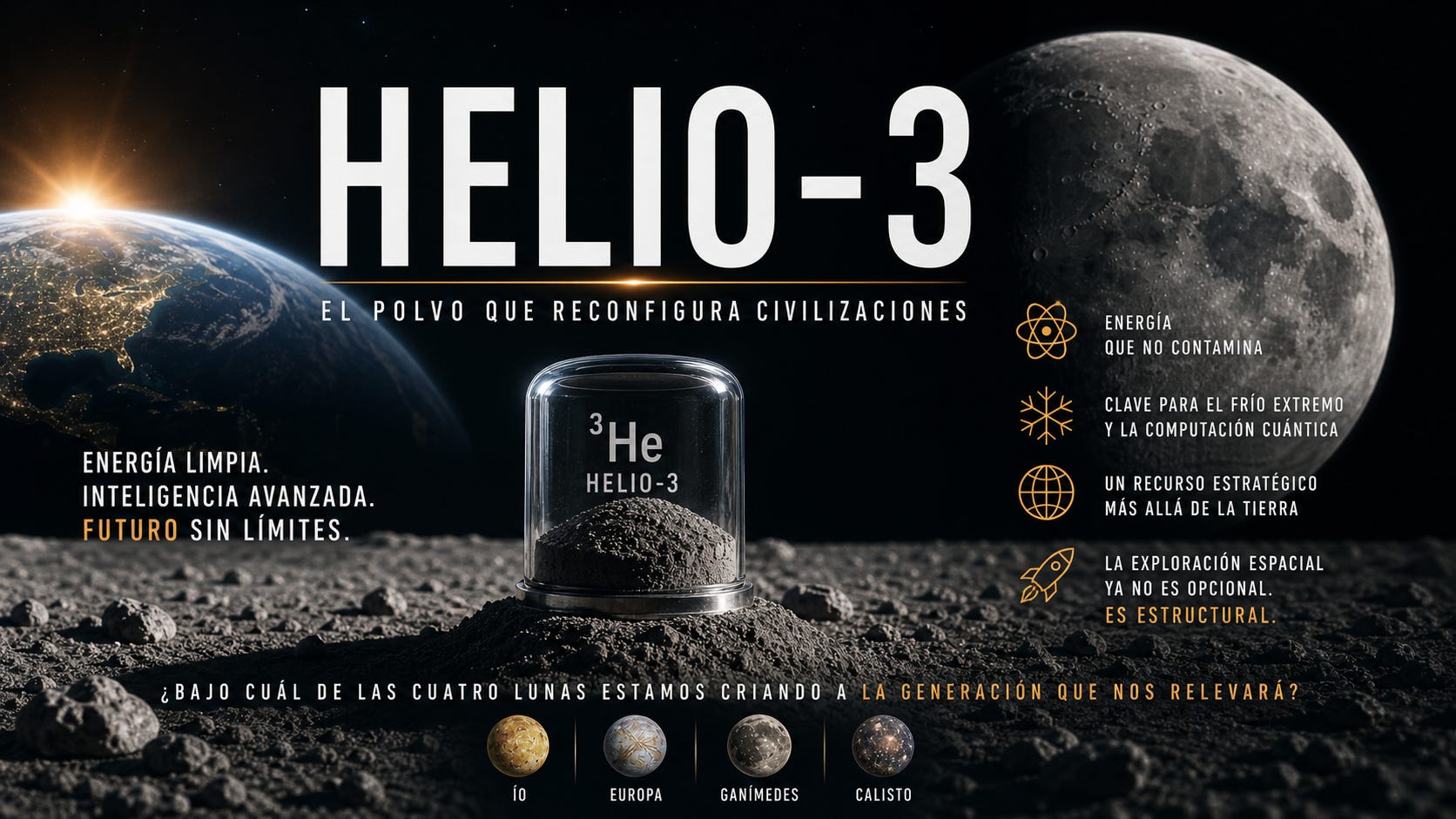
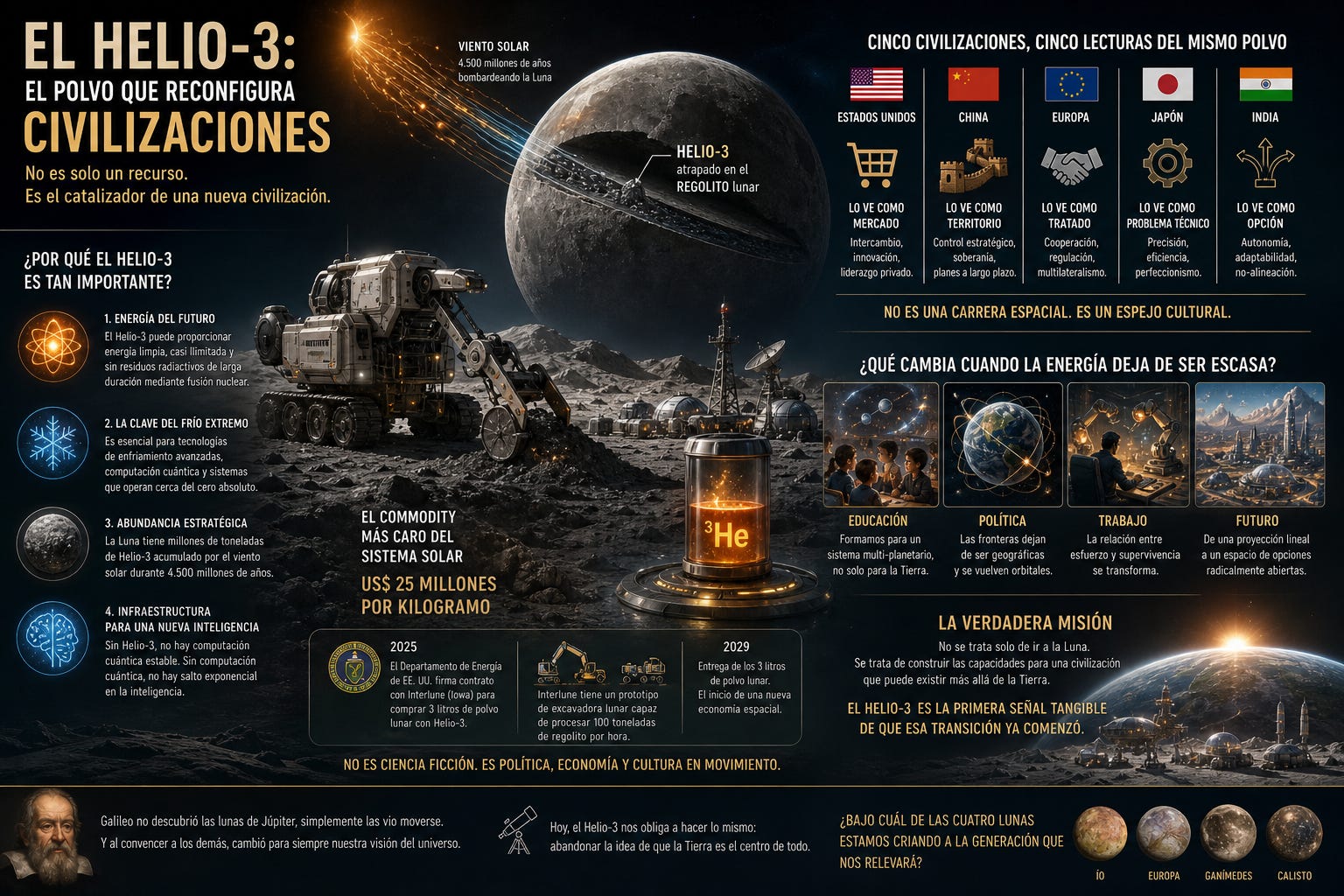
Three liters of lunar dust — that’s the quantity the U.S. Department of Energy (DOE) bought in 2025, to be delivered before 2029 by an Iowa startup called Interlune, which already has a prototype lunar excavator capable of processing a hundred tons of regolith per hour. Don’t get confused: these aren’t tons of ore, they’re liters of an isotope known as Helium-3, trapped in the lunar dust and in a few corners of Earth, deposited there over four and a half billion years of solar wind hammering the Moon’s atmosphere-free surface.
So why such a market price — twenty-five million dollars a kilo (a liter)? It’s no joke; it’s real, hard cash on the barrelhead. Helium-3 is the most expensive commodity in the solar system that has already had a first invoice cut for it — it already has confirmed customers, signed contracts, and order lines. Space mining stopped being science fiction the moment it stopped being discussed in sci-fi settings and started being discussed in the federal offices of the American government.
But here’s where the real action starts for entrepreneurs — and where the anthropological questions come in, which in the end are the only ones I care about: why are there five economies today looking at exactly the same dust, why did they simultaneously decide it was worth going to fetch, and why did they build five different architectures to do it? We anthropologists always love to start our analysis by reading the context. What an object gathers around itself — technology, capital, mythology, law, ambition — says more about the historical moment than the object itself. What Helium-3 is gathering is a fork in the modern economic spectrum, the kind that sometimes slips by unnoticed but happens only a handful of times per millennium. Let’s look at what I mean:
The United States treats Helium-3 as a commodity. Interlune + Vermeer + DOE. Purchase-order logic. A market.
China and Russia treat it as a geo-strategic position. The International Lunar Research Station, running parallel to the Artemis Accords. Supply-chain-control logic.
Japan treats it as a problem of technical elegance. Magna Petra + ispace: a 2026 mission that doesn’t excavate but captures the isotope by disturbing the surface. People getting creative.
The European Union treats it as a legal artifact. Moon Agreement 2.0 — you have to sign a treaty before you fly a mission. Logic of legal mediation, regulation, very European.
India treats it as a non-aligned option. Chandrayaan-3 already set hardware down at the lunar south pole. It plays its own destiny without signing on with any bloc.
There’s a sixth customer almost no one names, and it’s the one that will decide the real demand curve: quantum computing. The dilution refrigerators that cool qubits to millikelvin need mixtures of Helium-3/Helium-4. If nuclear fusion never arrives, quantum will — and it will be quantum, not energy, that drains the reserve. Helium-3 isn’t just the possible fuel of the next energy era. It’s also the cold required for the next co-evolution of intelligence.
More or less: five economies, six distinct demands, one single Moon. This is exactly what Galileo saw — more than one gravitational center in the system. Economies, as I said in the last edition and repeat here because it’s the thesis of FUTOPIX, don’t fail for lack of resources; they fail from misreading the signals. Reading the signals starts with accepting that every civilization is interpreting them, and the four moons are the four different futures in which one of these readings will hit the jackpot: Helium-3.
The Signals
Before we move into the four moons, let’s look at what’s already orbiting the competitive field of lunar exploration. These are verifiable facts as of April 2026.
Interlune + Vermeer already have their hundred-tons-per-hour lunar excavators ready. The DOE bought three liters for delivery before 2029 — a real customer, not a lead, not a prospect.
Magna Petra + ispace launch a no-excavation isotope-capture architecture in 2026. Japanese elegance against American muscle: a different philosophy, competing for the same dust.
ILRS (China + Russia) are consolidating an architecture parallel to Artemis. Two legal systems on the same Moon — it’s what the South China Sea was in the 2010s, scaled up to space.
The EU is pushing Moon Agreement 2.0. We already know these folks want to regulate before they extract. It’s the civilization that feels more at home writing the rulebook than playing the game. Because to play, you have to pay — the famous “ticket to play,” which in other parts of the world we call el CVY, or “¿Cómo Voy Yo?” — “What’s in it for me?”
India: Chandrayaan-3 already touched down on the lunar south pole in 2023. It has proven hardware and the capacity to play without signing on with anyone.
Quantum: if Google, IBM, or a Chinese player cracks qubit error correction at scale, demand for Helium-3 will overflow.
As always, the signals are unmistakable. What isn’t unmistakable is what they mean for ordinary mortals. In FUTOPIX TAKE 4 I called this movement the “cultural twist“: every technological trend is mediated by the society that absorbs it. Here the impact will be brutal — five economies, five ways of seeing the world, five bets on the future. The dust will stay the same; it’s the economy looking at it that decides which model of moon we’re going to inhabit.
The Dust That Will Reconfigure the Space Economy
There’s something deeply misleading about thinking of space exploration as an extension of geography. The truth is it isn’t. We’re not “going” to the Moon the way you cross an ocean. We’re rewriting the conditions under which a civilization can exist, and in that process, Helium-3 shows up not as one more resource but as a piece of infrastructure for this whole ontology — a material that won’t just feed machines, but will redefine what a society can imagine as possible.
Because if Buckminster Fuller taught us anything, it’s that when you change the energy base of a system, you don’t improve the civilization — you replace it.
For millennia, humanity has been trapped in an energy regime based on combustion: burn to survive. Burn wood, then coal, then oil. Every energy leap expanded our capabilities, but it also defined our limits. Politics, war, the economy, even the architecture of our cities, are direct consequences of how we access energy. In that sense, Helium-3 isn’t valuable because it’s expensive, but because it promises a completely disruptive break — clean energy, no combustion, no waste, no significant thermal friction. Energy that doesn’t destroy the environment that contains it.
But that’s where the shallow readings fall short. The real challenge isn’t the energy; it’s what happens afterward. When energy stops being the bottleneck — for quantum computing, among other projects — other systems will emerge as the constraint. That’s where the second layer of Helium-3 appears, quieter, more strategic: its central role in the architecture of extreme cold. In a world where quantum computing is starting to walk out of the lab, as Michio Kaku anticipated, the problem is no longer just to calculate, but to sustain impossible physical conditions. Temperatures near absolute zero, quantum stability, state coherence. Helium-3 stops being fuel and becomes a condition of possibility for a new co-evolution of intelligence.
This is where space exploration reveals its true nature. Not as a race for territory, but for the infrastructures that will support new forms of production.
The Moon, then, will stop being a romantic destination and become the logistical node of a larger system. A place where the absence of an atmosphere — once a problem — turns into an advantage. Where the solar wind, which for billions of years deposited Helium-3 in the regolith, becomes, in retrospect, a process of strategic accumulation. As if the solar system had been quietly stockpiling this inventory with no one to claim it.
Here comes the anthropological dimension underlying all of this: each economy isn’t competing for Helium-3, it’s projecting onto it its own way of understanding the world.
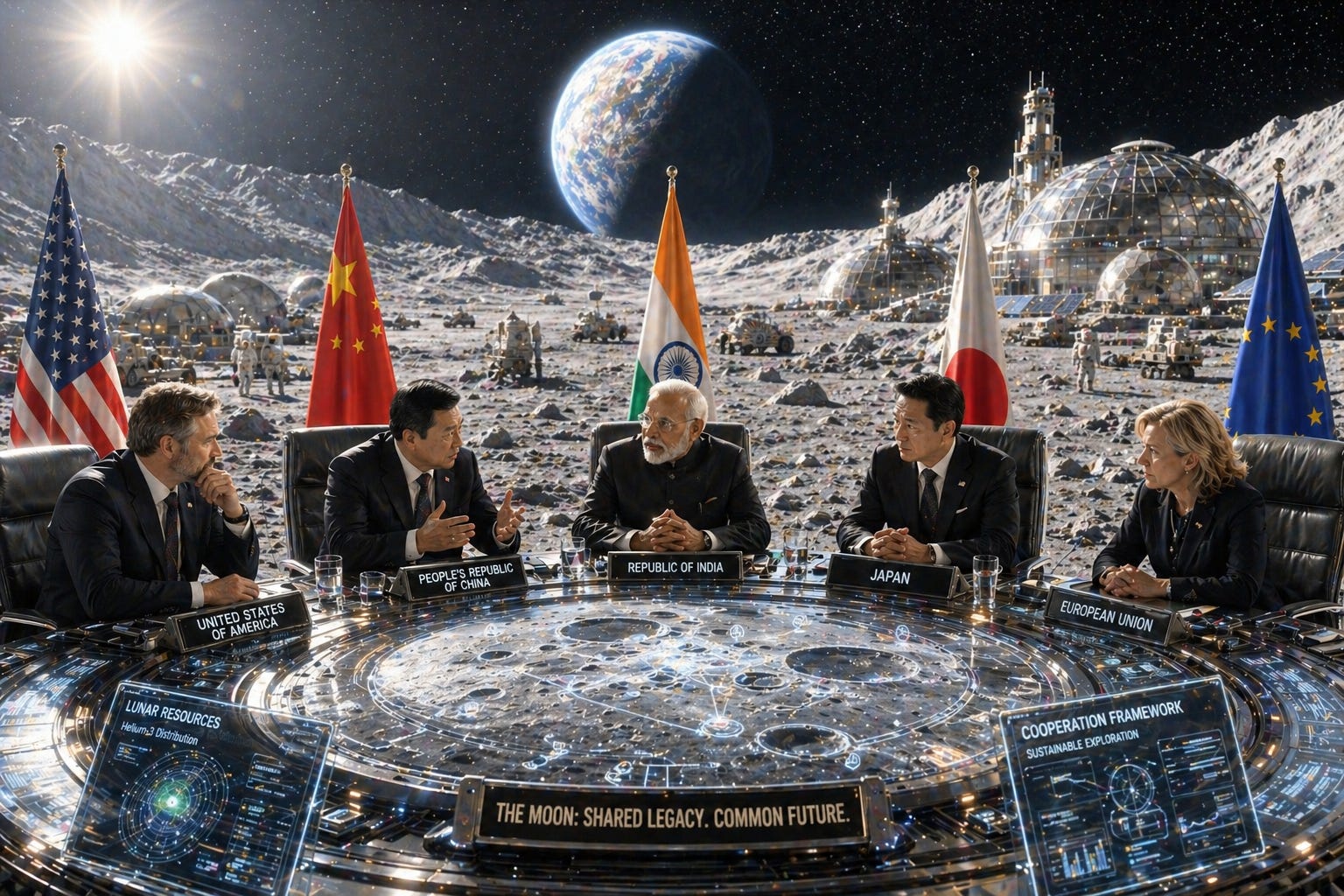
The United States turns it into a market because its founding mythology is one of exchange. China turns it into territory because its narrative is one of systemic control. Europe turns it into a treaty because its history is one of mediation. Japan turns it into a technical problem because its culture prizes precision. India turns it into an option because its identity is non-alignment.
What we’re watching is not a space race. It’s a cultural framework amplified by technology. In that mirror, Helium-3 works like a prism, because it forces us to answer an uncomfortable question: what kind of civilization do we want to be when scarcity stops being the organizing principle?
This is where a lot of models fall short, because they assume that energy abundance automatically produces well-being. But as Alvin Toffler warned, the problem has never been the availability of resources, but the speed at which societies can adapt to new conditions.
If tomorrow we solve energy, and we don’t solve humanity’s needs, we’ll be exposed.
Space exploration, then, is not a project of territorial expansion the way many want to frame it. It’s an experiment in production, one that forces us to confront our own cultural structures in an environment where the rules change faster than our institutions.
Helium-3 becomes the new modern gold rush — not because it’s the fuel of a new economy, but because it’s the future catalyst of technological co-evolution.
When Galileo saw the moons of Jupiter, he didn’t just discover objects; he discovered that the center was a relative thing, that what looks fixed is only a limited perspective on the universe.
Helium-3 is doing the same. It’s showing us that the Earth is no longer the operational center of our civilization. That the critical decisions — energy, computing, technological sovereignty — are beginning to shift off our planet. For the first time in history, we’re designing systems that don’t depend on terrestrial conditions to exist, and that’s the next frontier.
This will change everything. It will change how we educate ourselves, because we’re no longer forming individuals for a planet, but for a multi-planetary system. It will change how we do politics, because borders stop being geographic and become orbital. It changes how we understand work, because the link between effort and survival dissolves once energy stops being scarce. Above all, it will change how we understand the future — because the future is not a linear projection of the present, but a space of radically open options.
In that context, Helium-3 is not only the target of the new space race. It’s the excuse we needed to launch it. That excuse is what’s forcing us to build the capabilities we need to step outside our historical frame, to stop thinking like a terrestrial civilization and start operating like a spacefaring one.
Like every transition of this kind, it won’t be uniform or peaceful. There will be friction, conflicts, asymmetries. Some of the “moons” will be more attractive than others; some will win, others will vanish.
But what’s no longer up for debate is the direction of the movement. Helium-3 is, perhaps, the first tangible sign that the transition has already begun.
Don’t Ask Anyone to Bring You the Moon — Someone Might Actually Do It
For centuries, the sky was a limit. A place to observe, to project myths, to look for answers we couldn’t touch. Today, that same sky is turning into a layer of infrastructure we couldn’t even imagine before. Space exploration no longer answers to curiosity; it answers to the need to redesign our civilization from its foundations. Helium-3 emerges in this context not as a distant promise, but as a concrete sign that we’re entering a new phase: one where energy, intelligence, and territory stop being confined to Earth.
What’s truly transformative isn’t the possibility of extracting resources from the Moon, but the capacity to reorganize the logic under which we operate as a species. When energy stops being scarce, the rules of the game change: value will no longer lie in possessing, but in interpreting; no longer in competing for finite resources, but in building systems that amplify possibilities. Helium-3 is not just fuel, it’s context. A context that forces governments, companies, and entire cultures to rethink their place in a system that no longer has a single center.
Because we’re not facing a race for the Moon, we’re facing a test of how well we read the future. Some will see an economic opportunity in that dust, others a geopolitical advantage, others a technical problem.
Only a few will understand that what’s really at stake is the way we choose to co-evolve. Helium-3 won’t change the world on its own; it will change those who know how to read it.

DISCLAIMER
This document is intended strictly for informational, educational, and futurist-analysis purposes. It does not constitute financial advice, an investment solicitation, or a recommendation to buy, sell, or participate in any instrument, company, project, or asset.
If anyone uses the content of this material to solicit money, investments, or economic participation, treat it immediately as a possible scam.
Always protect your personal and financial information.