

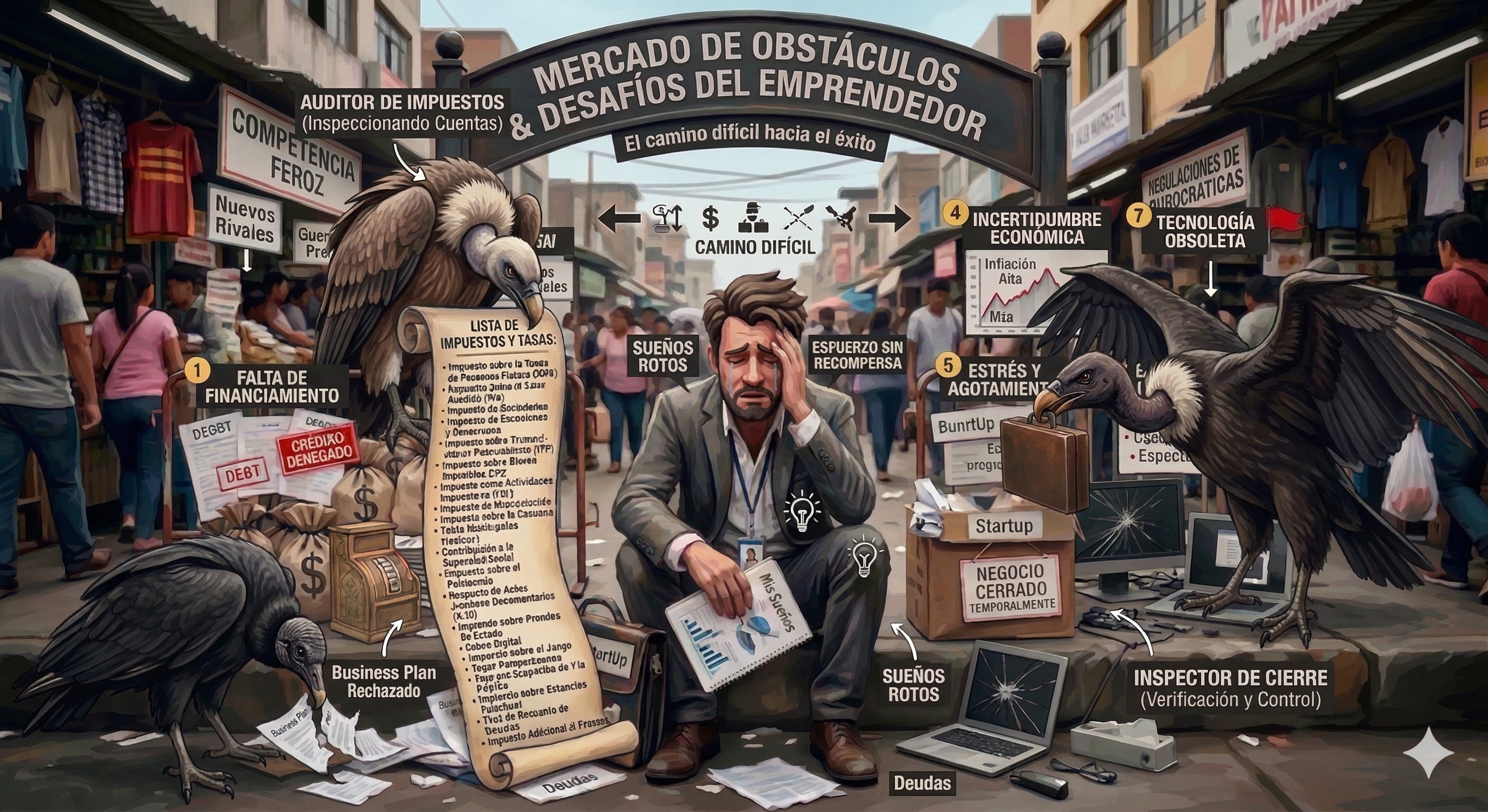
Founders Cry Too…
Not long ago I got to sit on a podcast with a group of fellow founders, swapping war stories about life as entrepreneurs — and digging into why some of us on the panel decided to leave Colombia to look for horizons where our ideas could actually echo.
Before we wade into all that, let me be clear: this take is not a grievance list against Colombia, the country we love and the nation that gave us birth. Quite the opposite — what I’m putting on the table today is a reflection that invites us to find better paths for building new companies.
As a futurist, it matters that you understand the circumstances of each system. Colombia is a country with an immeasurable capacity for producing founders. I’ve always said it and I’ll stand by it here: in Colombia, entrepreneurs sprout up from under the rocks. The problem is the system — which, and this isn’t just because we currently have a socialist/communist government, has always been designed to serve the economy of the past and was never built for the opportunities the future offers.
Now, if the current continuity candidate wins the election, it will be the end of any form of entrepreneurship in Colombia. Or can anyone name me the great brands born out of more than 60 years of socialism in Cuba or North Korea, or the unicorns coming out of economies like Venezuela and Nicaragua?
For a lot of hot-headed folks, it’s easy to talk about crybaby founders from the comfort of speculation, with zero data to back up the argument. So I’ll build this piece on real evidence and drop the sources at the end, in case anyone’s curious and wants to go deeper.
Enough turning the screw — let’s get straight into what brings us here today.
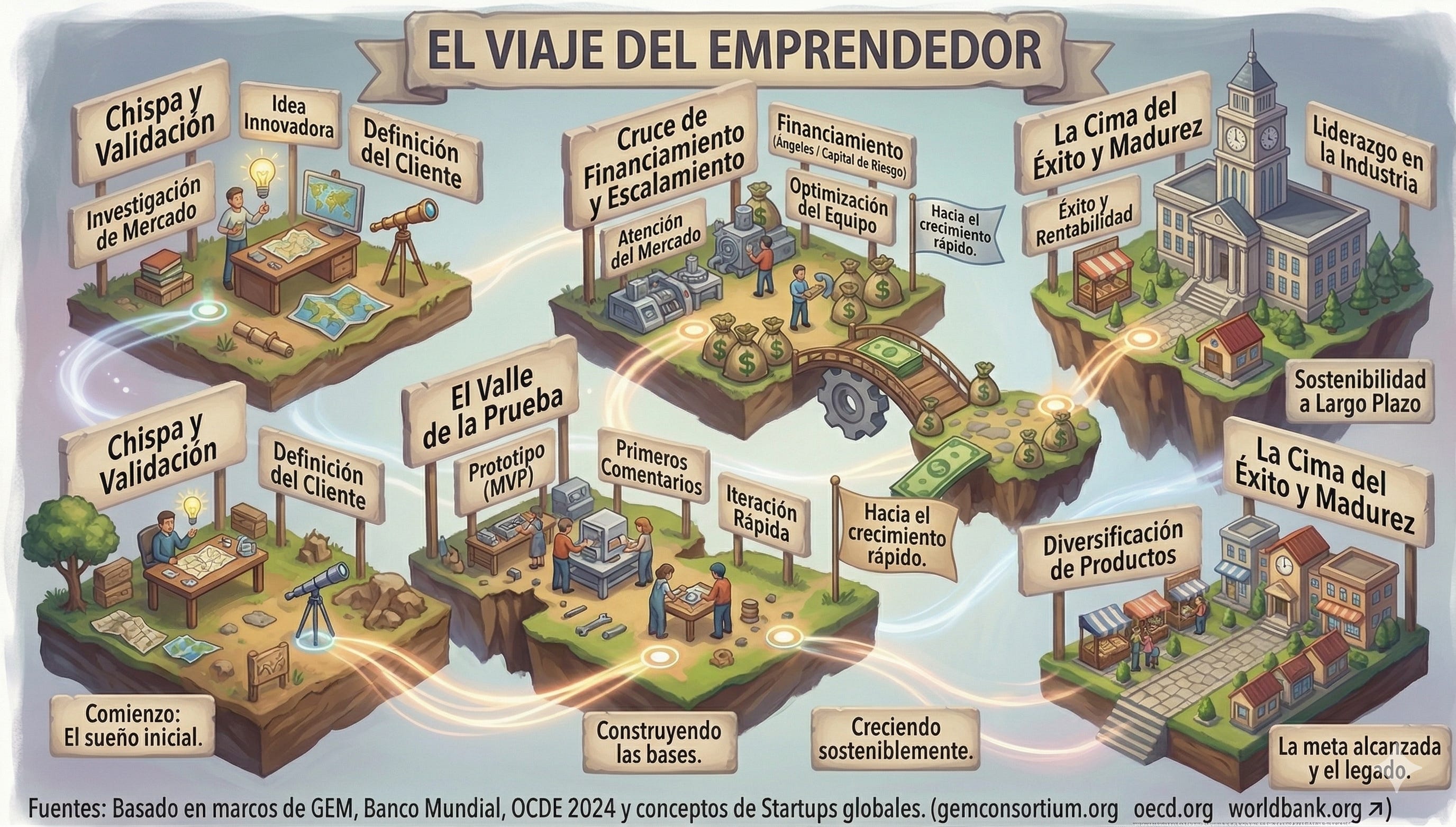
My life as a founder has dragged me through every moment of truth in the brutal job of building companies. I can say without a shred of doubt that I’ve been an entrepreneur for as long as I can remember.
My first memories go way back, when I was barely a kid. My father had bought some gardening tools to keep up the tiny patch of yard at the house where we grew up, in the La América neighborhood of Medellín. Those tools slept in a little storage nook under the stairs that climbed to the second floor of our house… And when I say they slept, I mean it literally: I almost never saw them used.
One day a gardener knocked on the door offering his services. My mother hired him, and soon it became routine. Every two or three weeks the man came to cut the little grass we had out front. Back then I figured it made no sense to keep tools locked away if nobody used them — and that’s how I decided to set up shop against “Don Pedro.”
So I started offering to mow the lawns and yards of the neighbors on the block. I even put together a little crew of buddies, going house to house “buzzing the grass.” The reaction from the stuck-up crowd didn’t take long: the folks who thought they were a class above quickly nicknamed us “the street urchins,” the girls stopped saying hello to us, and plenty of parents forbade their kids from mixing with the riffraff.
That’s where my rebellion against the system began. The truth is I couldn’t care less that they didn’t greet me — all I wanted was to make money.
When I ran out of yards to mow on the edge of the neighborhood, I jumped from gardening into recycling glass and newspaper. I walked the whole neighborhood knocking on the doors of neighbors and acquaintances, asking them to hand over their old bottles and papers — and honestly, business was booming. I piled up mountains of the stuff. My mom nearly threw me out of the house over the stacks of sacks I had piling up in the living room. I was a recycling tycoon.
At the tender age of 15 I made the leap to my first official storefront: a snack bar inside a well-known sports arena in the city, where I sold sodas and snacks to the fans who came to watch their athletes on weekends. I lasted three years there — until they shut me down for being a minor and a “risk” to the sports organization. At least that was the excuse for handing my business over to some other character.
From selling sodas, my entrepreneurial curiosity took another turn. During my university days I opened a carpentry shop in my house’s garage, inspired by a friend (bless his soul) who trained me in the art of wood framing. That’s where one of my great passions was born: furniture design. But the framing days were so long and exhausting that they crashed straight into my studies, so I had to close the workshop and shelve that adventure for a while.
During my days as a framer-carpenter I met a Panamanian businessman who imported all-terrain bikes from China. This kind of bike was just starting to trend (weak signals), which struck me as interesting. So I sank all my savings into bringing those bikes in from Panama, and I sold hundreds of them in just a couple of years. But the dream of becoming a big bike importer got cut short when a well-known businessman from Antioquia, with stores all over the country, went straight to my supplier to buy bikes and demanded market exclusivity. That day, my adventure in that industry was over.
As a university student I joined the underwater activities club at the Universidad Nacional in Medellín to practice another of my great passions: diving. Once again I blew what little savings I had left on the adventure. I got so hooked that, guided by a great friend and mentor, I traveled to the United States to certify as a dive instructor at a famous institute down in South Florida. I went from feeling like Cochise Rodríguez to a homegrown Jacques Cousteau.
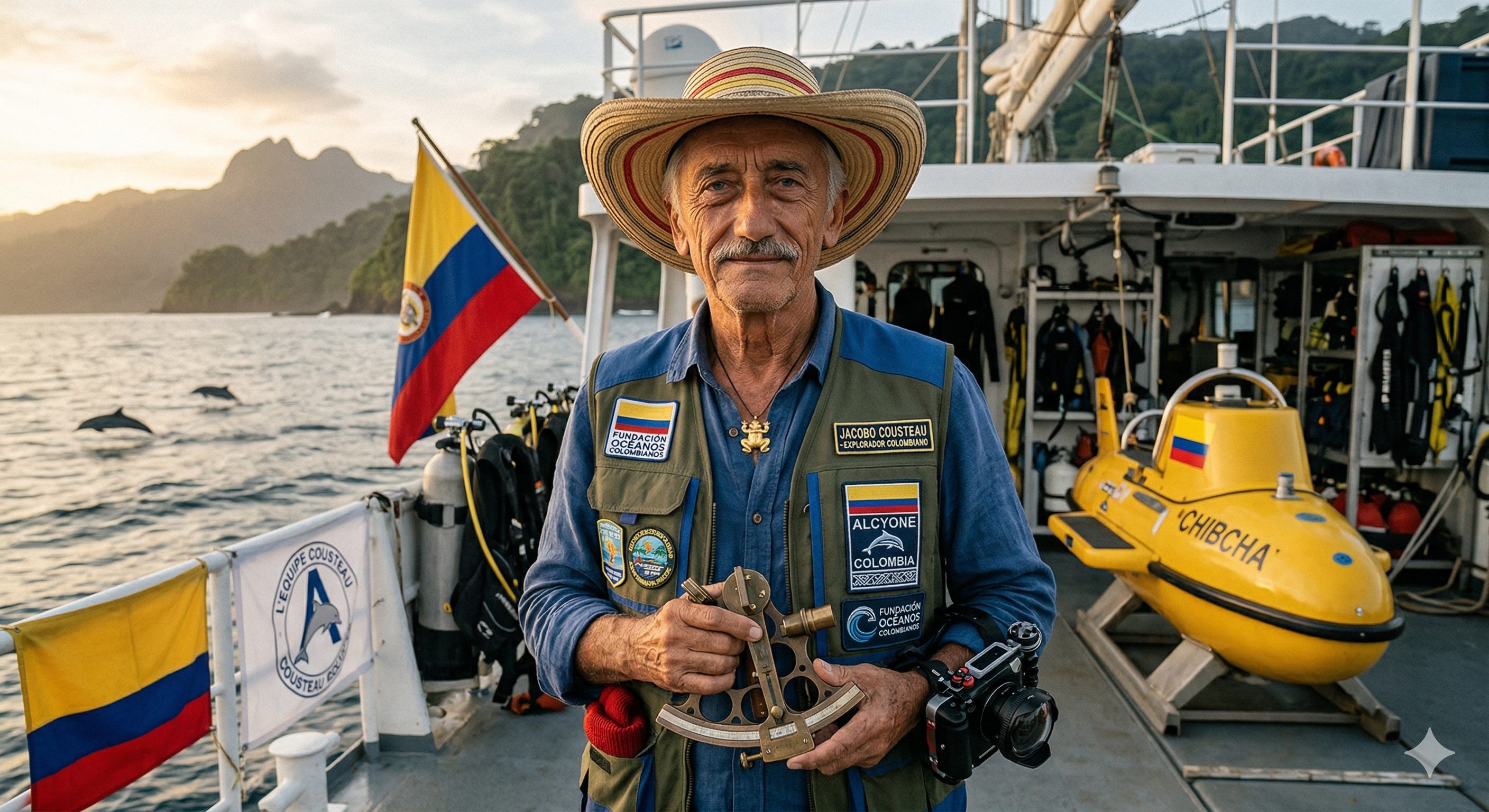
I landed in Miami for the first time at the ripe old age of 25, with a suitcase packed full of dreams. And honestly, the United States blew my mind: this country opened the doors of the world to me. I did everything legally to survive and earn my dive-instructor license. In that market I felt that the barriers I’d once hit in Colombia simply didn’t exist here. Back home, building a company was like racing cars in NASCAR; but in this country I had the whole track to myself. I never got a “no” or a “can’t be done” from the businesspeople who gave me the chance to work with them — on the contrary, every time I spotted a business opportunity, the answer was “go for it!” I spent a couple of years there, mostly dedicated to studying.
Once I got my instructor certification, I decided to head back to Colombia with the dream of opening my first dive school. And so it happened — against all odds, with no capital, no godfathers, and a whole lot of guts — Acqualand was born, the first dive school in the El Poblado neighborhood of Medellín. But as usual, the critics showed up right on cue. The old guard of Medellín diving said they’d made me an instructor in six months, that I had no experience; they blocked my access to the pools, wouldn’t fill my tanks — in short, so many hoops to jump through that today they’re just anecdotes. Those were years of hard work and also of prosperity. Diving gave me everything: money, great friends, and even the family I have today. I became a “quasi-surfer” with rich-guy airs; as a dive instructor I met Colombia’s most powerful people, on all sides of the fence. But over time, after so much abundance, I felt something was missing. I didn’t want to spend my golden years teaching diving, so I decided to fill that void with more academia.
I sold everything I owned — car, gear — and even ended a marriage that wasn’t making me happy, and I enrolled at the Universidad de Antioquia to study Anthropology. The Social Sciences knocked me flat on my belly and opened up a world of new possibilities. Along those lines, and together with two great friends (former dive students), I founded my first tech company, way back in the dawn of the so-called dot-com bubble: Ideas Avanzadas. Inspired by the analytical models of anthropology, we built grite.com, the first online survey service, in 1999 — when SurveyMonkey wasn’t even a glimmer in anyone’s eye.
We made hundreds of pitches to investors, but no incubator believed in us, no fund cared. Nobody would bet a peso on the project, because running online surveys in 1999 went against the status quo. We were 10 years ahead of the industry — at the time we were the best example of what weak signals really mean.
In 2001 I requested a meeting with the CEO of AOL/DMS (America Online — Digital Marketing Services) and flew to Dallas to make my first investor pitch abroad. I traveled with my current wife, the bedrock and emotional sponsor of my business adventures. I have to confess that before walking into the room I was scared out of my mind, a bit poisoned by all the rejection the idea had racked up in Colombia. But the surprise couldn’t have been bigger: I found an audience that listened with infinite attention and respect. Sure, they asked the tough questions — but always in a warm tone. That day I walked out of the AOL boardroom with an LOI (letter of intent) to acquire 40% of Ideas Avanzadas — IA and use it as the spearhead to expand DMS across LATAM. The celebration was short-lived, because that same week the Twin Towers attacks happened and the deal went to hell for a while.
After battling for months, we managed to salvage the initiative, but the operation to acquire a piece of IA ended up moving to Bogotá, since AOL had bought a well-known media outlet in the capital. To this day, in the year 2026, we’re still waiting for our dear Colombian partners to pay us our stake in the deal.
IA was my first serious setback. I was left with nothing — as we say in Medellín, we were left riding on the rims. Shortly after such a wipeout, a security company offered me a job in Brazil, and of course I took it. I saw the chance to work a couple of years in that country of wonderful culture and nature — until the entrepreneurship bug bit me again.
I split off from that company and opened up a franchise for a North American industrial degreaser company in São Paulo, alongside three local partners — huge mistake. If building a company in Colombia is hard, in Brazil it’s practically impossible. I spent two years fighting against corruption, bureaucracy, and institutions that simply don’t function. There I understood that Brazil is really two countries: the country of the businesspeople and the country of the politicians. Two polar opposites — and Colombia, sadly, isn’t far off from the same comparison.
Once again I was left riding on the rims, and I had to scrape together frequent-flyer miles just to get back home…
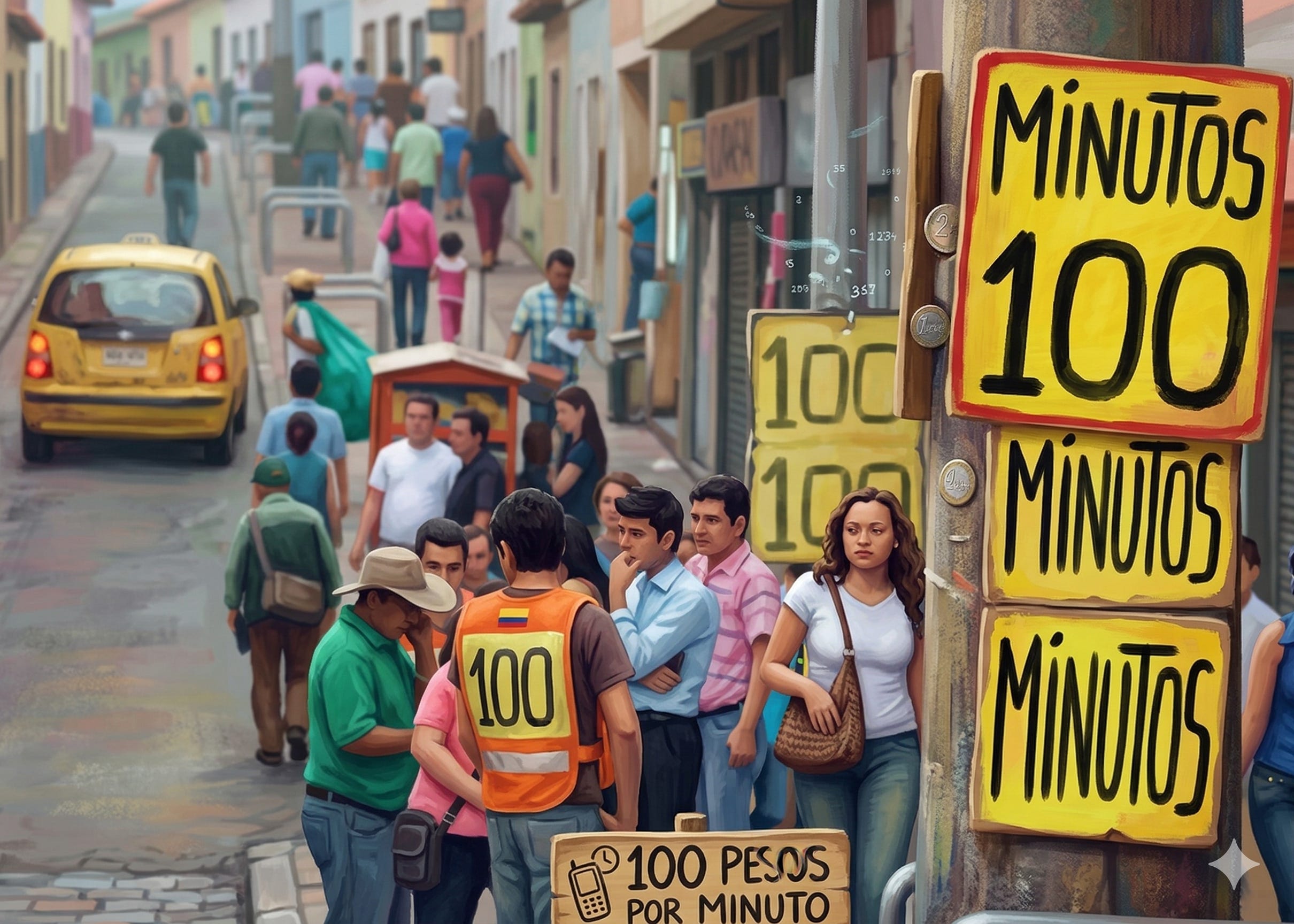
Self-esteem in pieces but with the heart of a founder intact, I pressed on. In 2009 I took the leap again, riding the boom in “minute selling” (yes — the business of renting out a phone to make calls).
I noticed that the practice was getting more and more popular (a weak signal in crescendo), and I remembered that back in São Paulo I’d met the CEO of a South African company that specialized in formalizing that exact business. I made some calls, set up meetings, and flew to Cape Town to meet with representatives of the owners — a company belonging to the De Beers family, one of the biggest players in the world’s diamond business. I came back to Colombia with the first license to operate community mobile telephony (truth is, they gave me a license for five countries). Psitek Andina was born — or Red Minuto, as it would later be known in the market. On paper, it was the perfect business.
But having a beautiful business on paper is one thing, and operating it is another. When it came time to launch operations, things turned ugly fast. The Colombian State’s bureaucratic hurdles for the business were brutal. The red tape was endless: you need a license for a cable, you have to certify a device, you have to pull a permit for an antenna, you have to pay a stamp fee, the seal has to come recommended, the lawyer has to review the commas, and on and on.
Red Minuto was the country’s first MVNO, and to push the idea forward I met with ministers, senators, business leaders, and even the lady who served the coffee in those institutions. But the answer everyone was really fishing for, in unison, was: “and what’s in it for me?” — the famous WIIFM.
One of the challenges we had to solve was presenting an MVP — Minimum Viable Product, so we set up a small Data Center in downtown Medellín, in an office my in-laws lent me across from the Camino Real Shopping Center. I went into debt down to the last available cent on my credit cards, on top of the loans from a few stubborn souls who trusted me. I knocked on every door of the country’s cellphone operators. But nobody seemed interested; many executives at those companies said my proposal would kill calling cards (which, by the way, were already dead by then). But through sheer insisting, resisting, and persisting, a Spanish executive at Movistar they called Chemas understood the signals of the business and believed in it from day one. Thank you, Chemas, wherever you are!
So we started running tests. We installed stations in Medellín and Bogotá. The technology worked perfectly. We had a market opportunity worth 35 million dollars in the first year alone. But for every step forward, we took two steps back. Until we hit the impassable roadblock: interconnection prices and the near-monopolistic market dominance of Claro. The rates we had with that company forced us to work at a virtual loss, and only Claro could fix it. After hundreds of hours of endless lobbying, they gave us the classic line: “don’t call us, we’ll call you.” We waited a year and a half for the call that never came. Red Minuto had to shut down.
Once again, with our tails between our legs, we liquidated what little was left to pay off the debts.
Not a dime in my pocket, and the only things I had left were my education and my experience as a founder.

During a trip to Cape Town back in 2009, I took the chance to go cage diving with great white sharks, a common activity down there. August is winter at those latitudes, and only a handful of crazies would think to dive in that cold — so on the boat there were just two lunatics: me and a Japanese guy who didn’t mutter a single word on the way out. We reached the dive site, geared up, and got in the water, and before long two enormous great whites showed up, each the size of a bus. It was a fascinating experience.
Coming out of the water, the once-mute Japanese man transformed into a chatterbox. He started talking nonstop the whole ride back, like a man who’d just been mugged. Between laughs he told me he was the CEO of Microsoft Research. I thought: “If the sharks had eaten him, it would’ve been on every news channel. Me, on the other hand — nobody would’ve even missed me.”
I did the same and told him I was an anthropologist, that I worked in technology, and that I was in South Africa on a business trip. When we got to port we went for food and a few beers, striking up a friendship that still lasts to this day. Between one beer and the next, he told me: “if you ever feel like working for Microsoft, get in touch — I can throw some projects your way.”
So, after the failure of Red Minuto, I called my friend Kentaro. And that’s how Xcouter was born, the company that has put food on my table ever since.
But why drag all this narration into the presentation? The goal is one and only one: to show you there’s no such thing as the crybaby founder, the victim, the way some people like to paint it. When you play the victim, you tend to pin the blame for your failures on everyone else — and if there’s one thing I’m clear on after decades of building companies, it’s that all my defeats were my own responsibility. And despite everything I suffered, I never felt like a loser; I always turned what I learned into working capital. Now, that it’s easier to build a business in some places than in others is a plain fist-to-the-table truth that can’t be denied. Looking for the best conditions to develop your creativity and enterprise isn’t a matter of being a crybaby or not — it’s a matter of survival.
What the Data Says
Colombia is hard for founders not because it lacks entrepreneurial spirit, but because the country makes the jump from starting a business to scaling it unusually complex.
The GEM reports show that in 2023 nearly one in four adults in Colombia was starting or running a new business, but only one in 30 had a consolidated company. GEM points out that consolidating a company means clearing “serious obstacles.” The score for the entrepreneurial environment fell to 4.1 (ranked 37th of 49), and WIPO placed Colombia 61st in the 2024 Global Innovation Index.
The central point is clear: Colombia generates founders; the United States generates scale. Colombia has energy. The United States has deep capital, innovation infrastructure, and a system that turns startups into durable companies.
Colombia’s problem is systemic. If you want, call me a systemic crybaby.
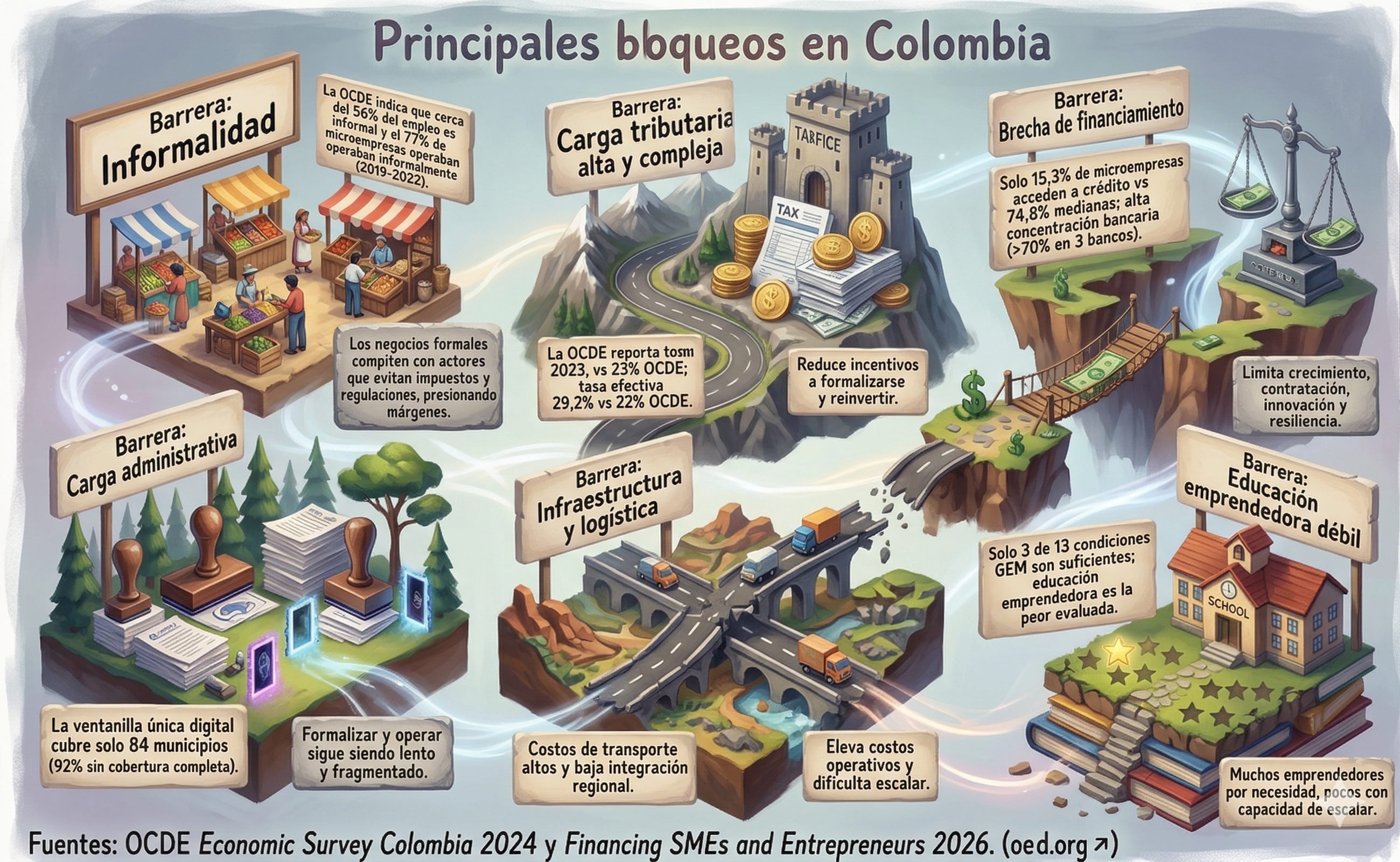
The main roadblocks for founders in Colombia
Informality: 56% of employment and 77% of microbusinesses operate informally (OECD 2019–2022). The formal ones compete at a disadvantage.
High, complex tax burden: A corporate rate of 35% (vs. the 23% OECD average).
Financing gap: Only 15.3% of microbusinesses can access credit.
Administrative burden: The digital one-stop window still doesn’t cover the whole country.
Infrastructure and logistics: High costs that make scaling difficult.
Weak entrepreneurial education: The worst-rated in GEM. Necessity-driven entrepreneurship dominates.
Why is it harder to build a company in Colombia than in the U.S.?
In the United States the challenge is to compete and scale. In Colombia the challenge is to survive the system + compete + scale.
Why are some of us founders crybabies?
It’s not for lack of drive. It’s because of everything the system lacks to turn that drive into big companies that export and generate quality jobs.
In my humble opinion as a crybaby founder, I believe Colombia doesn’t need more incentives to launch startups, more people making jams and pickles. It needs to redesign the system so companies can emerge on solid foundations that survive and can scale.
The root problem is the systemic friction accumulated over decades: you maximize the entry of new businesses, but you penalize their growth. The Colombian company-building system lets you be born, but the very conditions of that system won’t let you fly.
To change this, we have to keep crying until the establishment focuses on building at least the following strategic levers:
Smart formalization (attacking the root)
A progressive, phased tax regime (a “startup tax ladder“): minimal burden for the first 2 years and a gradual increase afterward.
Impact: more early formalization and less unfair competition.
Credit as infrastructure
Alternative scoring based on real data, massive guarantee funds, and open APIs for fintechs.
Impact: democratize credit and shrink the valley of death.
Radical simplification of the operating system
A national one-stop window, 100% digital, that actually works in every municipality. A single flow for registration, taxes, and social security.
Impact: drastically cut the time and cost of formalization.
Infrastructure to scale
Priority logistics corridors, temporary subsidies for exporting SMEs, and digitization of supply chains.
Impact: reduce costs and enable regional and international expansion.
Re-engineering entrepreneurial talent
Mandatory entrepreneurial education starting in school, scale-up programs (not just incubation), and real alliances between universities and industry.
Impact: shift from necessity-driven entrepreneurship to high-value entrepreneurship, innovation, and exports.
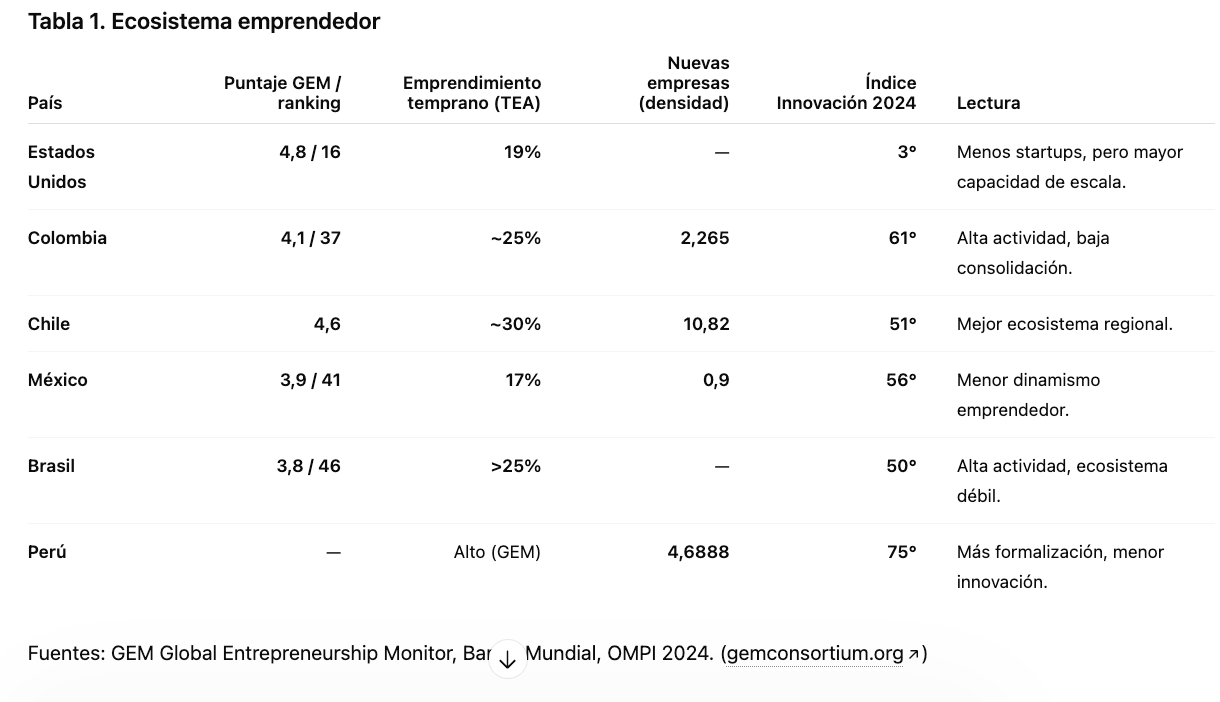
Now, comparing Colombia to the United States is a bit unfair and lopsided. To make the debate more balanced, let’s look at the neighborhood to see how we stack up against our backyard competitors. I invite you to study the following table:
LATAM: Plenty of Energy, Little Conversion
The table above reveals something that, for those of us who’ve lived entrepreneurship in the region, is no surprise — but it does expose structural problems. LATAM doesn’t have an entrepreneurship problem; it has a problem turning entrepreneurship into scalable companies.
Colombia (~25% TEA), Chile (~30%), Brazil (>25%), and Peru all post high indicators, showing a clear pattern: the region produces founders en masse. This is no trivial matter. From my anthropological perspective, the data is telling me about highly adaptive societies, where the individual responds to uncertainty with their own initiative. It’s what Harari would call a cultural capacity to reorganize reality in the face of scarcity.
But here’s the fracture that brings the tears to my eyes: high creation doesn’t mean high consolidation.
Colombia, for example, combines a high TEA with a low innovation index (61st) — lots of jam factories and very few disruptive innovation efforts. The reading is clear: high activity, low consolidation. Brazil replicates the pattern: lots of activity, a weak ecosystem. Peru shows more formalization, but falls even further in innovation (75th). Mexico, on the other hand, can’t even sustain entrepreneurial dynamism.
This leads us to a first conclusion. LATAM is a factory of attempts, not of consolidated results — and that’s where we differ from the United States.
Chile: The Relative Exception
Chile shows up as the most balanced system in the region. It keeps a high TEA while improving its position in innovation (51st) and in the quality of its ecosystem. This doesn’t mean Chile has solved the problem, but it has advanced on something critical: reducing systemic friction.
Programs like Start-Up Chile, clearer regulatory frameworks, and better access to capital have kept entrepreneurship from staying stuck at mere intention. Chile doesn’t have more talent than the rest of LATAM. It has better conditions for that talent to survive.
The United States: The Structural Contrast
The contrast with the United States is brutal and revealing. A lower TEA (19%), but:
A better GEM environment (4.8 / 16)
Top 3 in global innovation
Fewer founders, but more real companies, more scaling… This shatters LATAM’s central myth: the one that says we need more people starting businesses.
The truth is no, we don’t need more people starting businesses. We need better systems to scale the entrepreneurship that already sprouts up from under the rocks — and if that makes us crybabies, then I’ll keep crying until the people in charge of policy finally get the message.
The United States doesn’t beat us because its people try harder, but because the system converts better — capisce!
Capital, infrastructure, a homogeneous market, functional institutions… everything converges on a single point: lowering the cost and friction of scaling.
The Crybaby Paradox
If we connect all the dots, a deep paradox emerges: LATAM is one of the most entrepreneurial regions in the world… and at the same time one of the least efficient at creating durable companies.
This produces an invisible but critical phenomenon:
High human burnout
Low structural productivity
Fragmented innovation
Talent flight (as my own story proves)
Through Toffler’s logic, LATAM is trapped between two waves:
An incomplete industrial economy
A poorly implemented knowledge economy
And in that in-between space, the founder is left exposed.

I Don’t Cry for Sport, I Cry for What Could Be
After telling you part of my story — from the street urchin buzzing lawns in the La América neighborhood to founding Xcouter.com and SmartHOS.io, passing through failures that left me penniless — I’m not here to play the victim. I am not a crybaby founder. I’m a founder who got tired of slamming into the same wall over and over again.
Colombia has a brutal entrepreneurial energy. Founders spring up in every corner of the country. There’s grit, creativity, and drive to spare. The problem isn’t the people. The problem is the system: a system designed to let you be born, but not to let you fly. A system that rewards informality, punishes growth, drowns you in paperwork, and forces you to survive instead of scale.
I’ve lived in my own flesh what the data from GEM, the OECD, and WIPO says. I’ve felt informality in my own pockets — the lack of credit, the bureaucracy, and the “what’s in it for me.” And yes, I’ve also seen what happens when you cross the border: suddenly the same effort pays off ten times more. Not because I’m smarter, but because the ecosystem lets you breathe.
This isn’t about abandoning Colombia. It’s about refusing to romanticize a system that punishes anyone who wants to grow. We don’t need more motivational speeches or more incubators celebrating pretty failure. We need to change the rules of the game: smart formalization, real credit, radical simplification, infrastructure to scale, and education that produces high-value founders, not just survivors.
If Colombia wants to stop exporting talent and start retaining it, the change can’t be cosmetic. It has to be structural. Because as long as we keep maximizing the entry of new businesses and penalizing their growth, we’ll keep producing microbusinesses that never take off and founders who, sooner or later, end up looking abroad.
I’ve already made my decision. I left so I could fly. But I still believe, with all the grit I have left, that Colombia can be a great country to build in. All that’s missing is for the system to stop putting up roadblocks and start giving us wings.
To those who stay and keep fighting from the inside: respect and admiration.
To those who, like me, chose to look for other horizons: may it go well for us — but may we never lose the hope of one day seeing a Colombia where we don’t have to choose between staying and growing.
The future isn’t cried into being. It’s built with less speech and more sweat. May we build it together, without so much systemic weeping.
Meanwhile, I’ll keep singing to the sun like the cicada… so many times they killed me, so many times I died, yet here I am rising again, giving thanks to misfortune and to the dagger-wielding hand that killed me so badly it kept me singing!
**Sources
SUPPORTING ARCHITECTURE OF THE ANALYSIS**
1. Empirical Core — Entrepreneurial Ecosystem (Reality Base)
(This is where the hard evidence lives. What isn’t up for debate gets measured.)
Global Entrepreneurship Monitor (GEM)
Colombia Profile
https://www.gemconsortium.org/country-profile/52
Data used:
Total early-stage entrepreneurial activity rate (TEA), proportion of established businesses, motivation (necessity vs. opportunity), ecosystem score (EFC), global GEM ranking
United States Profile
https://www.gemconsortium.org/country-profile/122
Data used:
Entrepreneurial environment score (EFC), structural TEA comparison vs. Colombia
2. Innovation System — Scaling Capacity (Future Indicator)
(Here we measure who can turn energy into progress.)
World Intellectual Property Organization (WIPO)
Global Innovation Index 2024
https://www.wipo.int/en/web/global-innovation-index/2024/index
Data used:
Global innovation ranking (Colombia, U.S., Chile, Brazil, Mexico, Peru)
3. Systemic Infrastructure — Structural Constraints (What Holds the System Back)
(Here is the invisible friction: where good ideas go to die.)
OECD – Economic Survey of Colombia 2024
Data used:
Labor informality (~56%), infrastructure quality, institutional environment, structural limitations of the ecosystem
OECD – Financing SMEs and Entrepreneurs 2026 (Colombia)
Data used:
Access to credit (micro vs. medium-sized companies), banking concentration (>70%), business informality (~77% of microbusinesses)
4. Business Dynamics — Conversion to Formality (The Scaling Pipeline)
(Here we see whether the system converts intention into a real company.)
World Bank – Entrepreneurship Database (via Trading Economics)
https://tradingeconomics.com/colombia/new-business-density
Data used:
New business density (Colombia, Chile, Mexico, Peru)
5. Strategic Framework — Interpretation and Action (Cognitive Layer)
(Here lives the “how to think,” not the “what to measure.”)
McGrath, Michael E. – Product Strategy for High Technology Companies
→ Scalability, differentiation, and growth architecture
Li, Charlene & Solis, Brian – The Seven Success Factors of Social Business Strategy
→ Organizational alignment, execution, and resources
McKeown, Max – The Strategy Book
→ Strategic fundamentals and environmental analysis
Hillen, John – The Strategy Dialogues
→ Decision-making in complex contexts
Godin, Seth – This Is Strategy
→ Systemic view of markets and positioning
Whitehead, Jo – What You Need to Know About Strategy
→ Operational definition of strategy and decision logic

DISCLAIMER
This document is intended exclusively for informational, educational, and futurist-analysis purposes. It does not constitute financial advice, nor a solicitation to invest, nor a recommendation to buy, sell, or participate in any instrument, company, project, or asset.
If anyone uses the content of this material to solicit money, investments, or economic participation, consider it immediately a possible scam.
Always protect your personal and financial information.