

Genesis
Six months have passed since we first met here at FUTOPIX. It’s been an extraordinary ride for me. This little corner of the internet has helped me exorcise my demons and, at the same time, cracked open a door for me to express myself. I have to confess that at the start I was writing purely for myself, expecting nothing in return, like someone tossing a bottle into the sea with the secret hunch that somebody, on some far shore, will eventually find it and read the message tucked inside. But as the weeks went by, your comments have kept egging me on to keep this thing alive, episode after episode, week after week. Before I begin, I want to thank you for these six months and for making it this far, because if you read me every week, it’s because my essays give you something. I hope to keep doing exactly that for a long time to come. I also want to tell you that new projects are on the way, and I’ll be sharing them through this channel, like someone opening new rooms inside the same house.
The piece I’m bringing you today was hard to write. It may be the hardest of the 26 I’ve tackled since I started this adventure, and I don’t say that because the subject itself is so difficult, but because of the sheer number of debates that creativity has sparked across the ages. There are words that look transparent, but when you try to touch them, you discover they’re made of layers, of sediment, of centuries of accumulated argument. Creativity is one of them. We all think we understand it until we try to define it rigorously, and at that moment the concept turns slippery, shifting, almost untamable, gaseous.
I decided to write this piece about the creativity/AI relationship as the result of several conversations with friends, students and coworkers. I sense there’s a certain whiff of fear and ignorance around that relationship, a strange cocktail of fascination and suspicion, of enthusiasm and threat, so I wanted to give myself the room to write a bit about it. After four essays’ worth of deleting, editing, copying and starting over, I think I finally feel at peace enough to lay out my views on the matter.
I naively began by writing down the vox populi ideas of what most of us consider creativity, or the art of making the new, and every time an idea landed in my mind, I couldn’t help wondering, in parallel, whether that same conceptual gesture could be pulled off by a computational intelligence. As I moved through the questions, I kept running out of easy answers, until only a handful of paths were left on the table for understanding, with any seriousness, what it actually means to be creative.
Don’t think the text you’re reading today came easy. The truth is I had to push myself harder than usual to get here. I had to go back to my notes as an anthropology student to recall concepts and dig up authors who really know this terrain, so I could escape the shallowness with which so many treat this subject and hand you something a touch more rigorous, but that would still give us a decent map for moving forward along the road of ideas. Because there are subjects that today get discussed far too fast, almost as if having an opinion were enough to crown ourselves experts. That, precisely, is one of the risks of our era: confusing speed with depth, repetition with thought, and familiarity with understanding.
Along these lines, to explain what creativity is, we first have to understand what an idea is. This is a question that psychology and anthropology have asked themselves ever since they existed as disciplines. Without hesitation, my favorite author for understanding what ideas are is Gregory Bateson, an anthropology classic that all of us who carry the title simply have to read. Bateson has a wonderful body of work called Steps to an Ecology of Mind; I recommend it to anyone who wants to read a scientific text bursting with ideas and concepts, because it changed my life, at the very least.
Today I can say that, as an anthropologist, I’m profoundly Batesonian, though my anthropological DNA also carries a little bit of Chomsky, Lévi-Strauss, De Saussure, Morin and Capra, among others. You don’t think from a single author, but there are authors who become a kind of backbone of your thinking, and Bateson, at least in my case, occupies that spot.
To explain what an idea is, Bateson centered his studies on children, from newborns to adolescents. The basic question in his research model was how ideas take shape. To that end he observed how we humans learn, and he ended up classifying learning into three levels that, roughly speaking, he called the sensory, the categorial and the conceptual. Along these lines, he discovered that during our first years of life we discover the world through the five senses.
That’s why, when a baby eats dirt, in what pediatricians call the oral stage, it’s basically stress-testing its sensory system. Bateson argued that our brain thinks by generating comparisons in order to extract differences. That’s how babies learn to classify things according to the stimuli produced in the brain, and then extract the difference. When the baby eats dirt, its brain is comparing the taste of dirt with other, previously learned tastes: milk, purée, soup, and so on. The sensory system identifies the taste, processes it, and extracts the difference. In the Batesonian world, then, an idea is the result of comparing things and extracting the differences: idea = difference.
Here it’s worth pausing a moment, because this seemingly simple formulation holds enormous depth. If an idea is a difference, then thinking doesn’t consist merely of accumulating information, but of learning to distinguish, to discriminate, to perceive what separates one thing from another. Thinking isn’t piling up data like someone filling a warehouse; thinking is perceiving relevant differences. This matters when we start comparing human intelligence with artificial intelligence, because a machine also detects differences, but it detects them in a radically different way. The machine identifies statistical distances, correlations, probabilities, patterns within mathematical spaces; the human, by contrast, extracts differences that then get embedded in a symbolic universe. For an AI, a difference can be a variation inside a vector; for a human, that difference can turn into meaning, memory, judgment, emotion, metaphor or destiny. That’s where a decisive fault line begins to open up between the two kinds of intelligence.
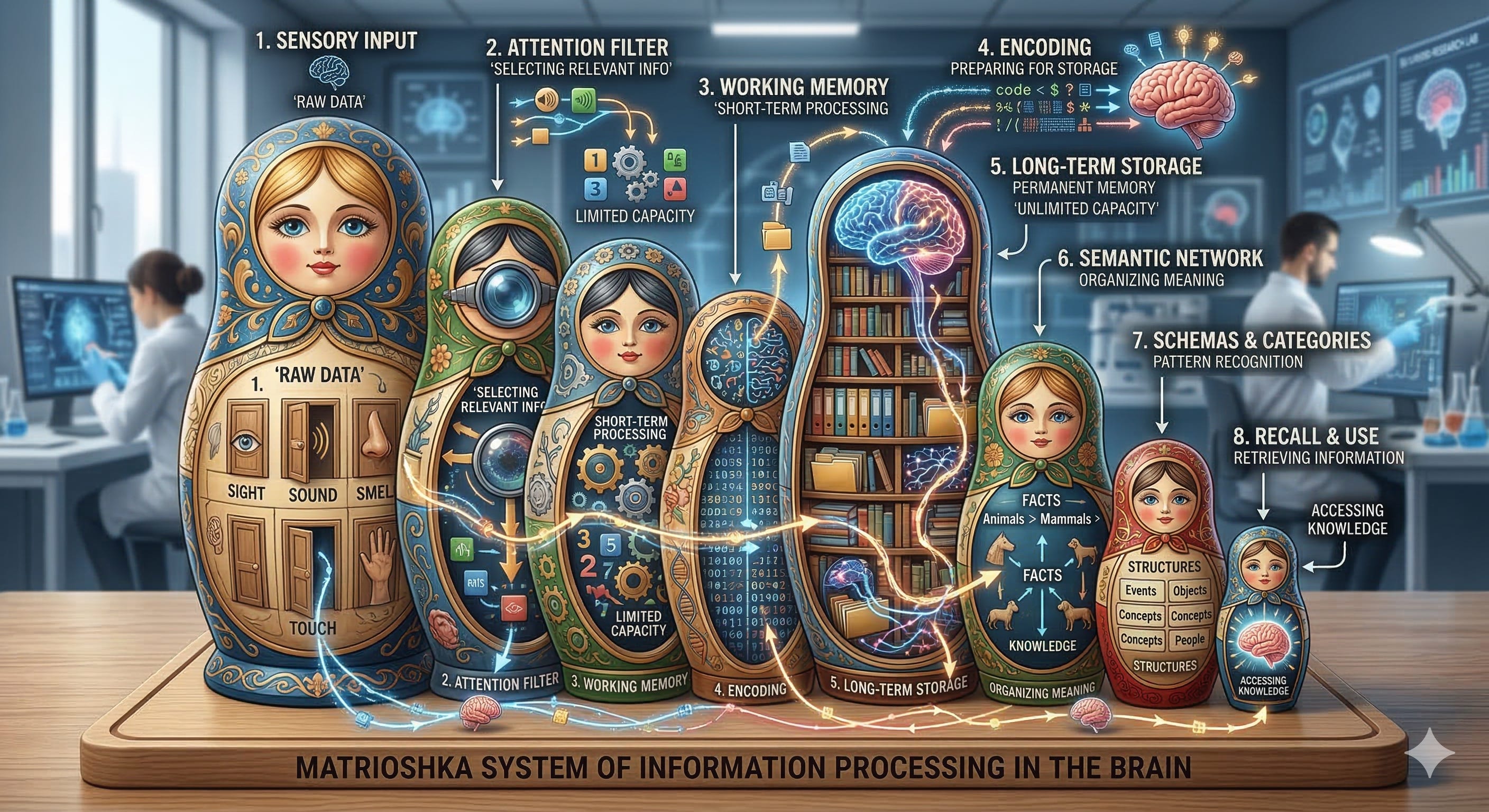
Later, as we near seven years of age, we begin climbing to the next level of cognition, the level of categories. According to the Batesonian postulates, our brain takes those differences = ideas and orders them into categories.
It’s something like a set of Matryoshka dolls, where information gets organized according to what was learned at the level of the senses. Our categorial system organizes information according to our life experience and the cultural (symbolic) system in which we’re immersed. Let me open a parenthesis here to invite you to think of culture as a movie screen; it’s a gaseous, liquid thing onto which we project our life experience. It’s the screen where each society projects its own film, or to put it another way, it’s the operating system of society, where we install the set of beliefs within which we live, feel, interpret and even dream.
Back to the categorial system: Bateson says we organize ideas according to our experience, and we subject that experience to a classificatory system that sorts emotions into good or bad, fast or slow, sweet or salty, beautiful or vulgar, sacred or profane, and it keeps feeding itself until it manages to build what we understand as cosmogonies. Now, we spend practically our whole lives living in the categorial, so when do we acquire the conceptual? For Bateson, we all have the capacity to think conceptually, but it requires a capacity that’s scarce in many of us, and that’s the capacity to build contexts. Here, in my view, a central part not only of what we understand as creativity, but of intelligence itself, begins to play out.
Let me give you an example: take a sheet of paper; I’m going to ask you to think of a tree and draw it… with absolute certainty, most of you will draw an image resembling the following:
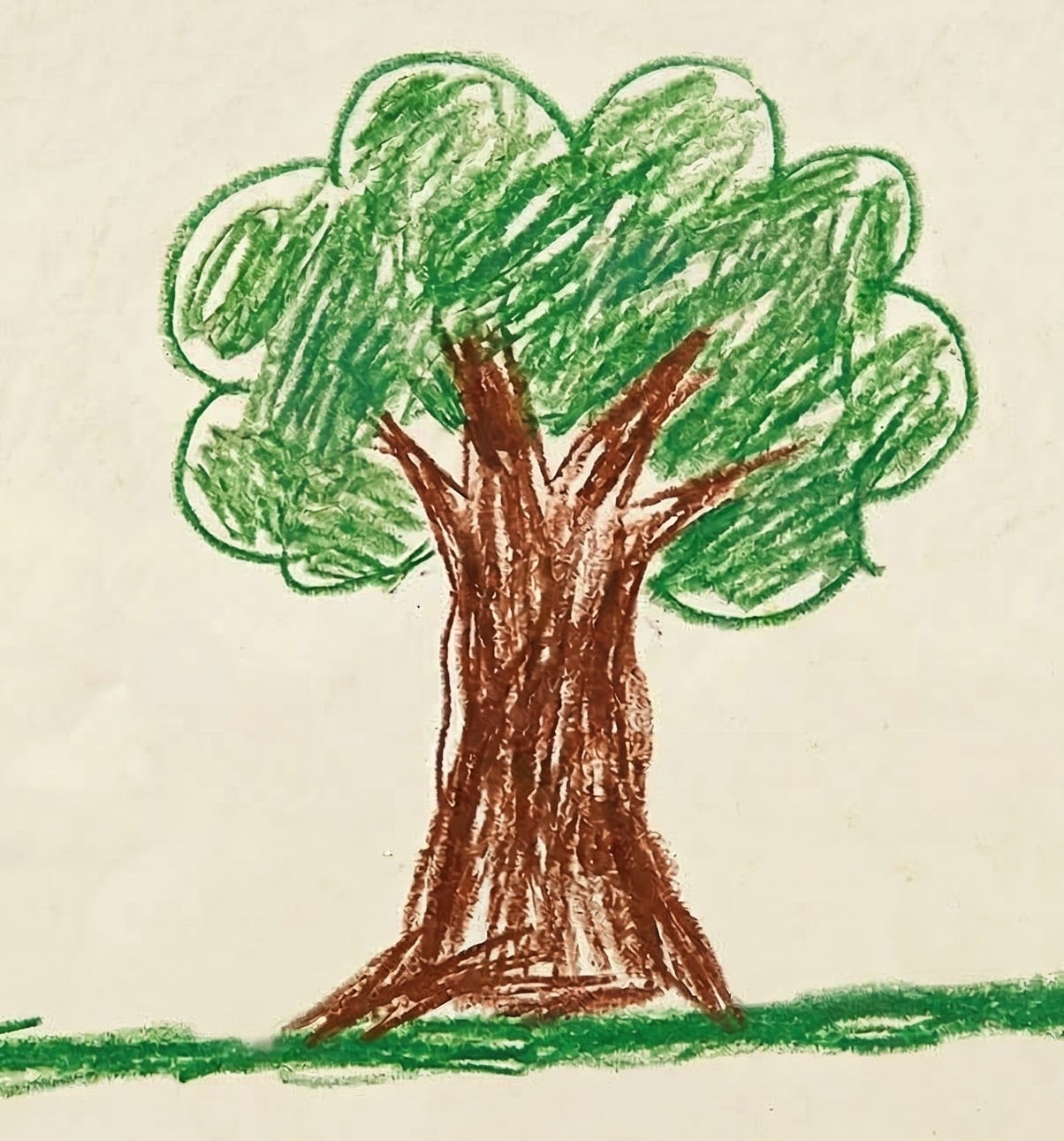
In our minds we hold a default idea, set by the context of experience we grew up in, of how trees are represented. This first abstraction belongs to the world of the sensory; it’s the way we learned to visualize trees when we were kids. Next, I’d like you to think of and draw an apple tree, for which most of us would proceed to draw an image like the one I’m showing you below:
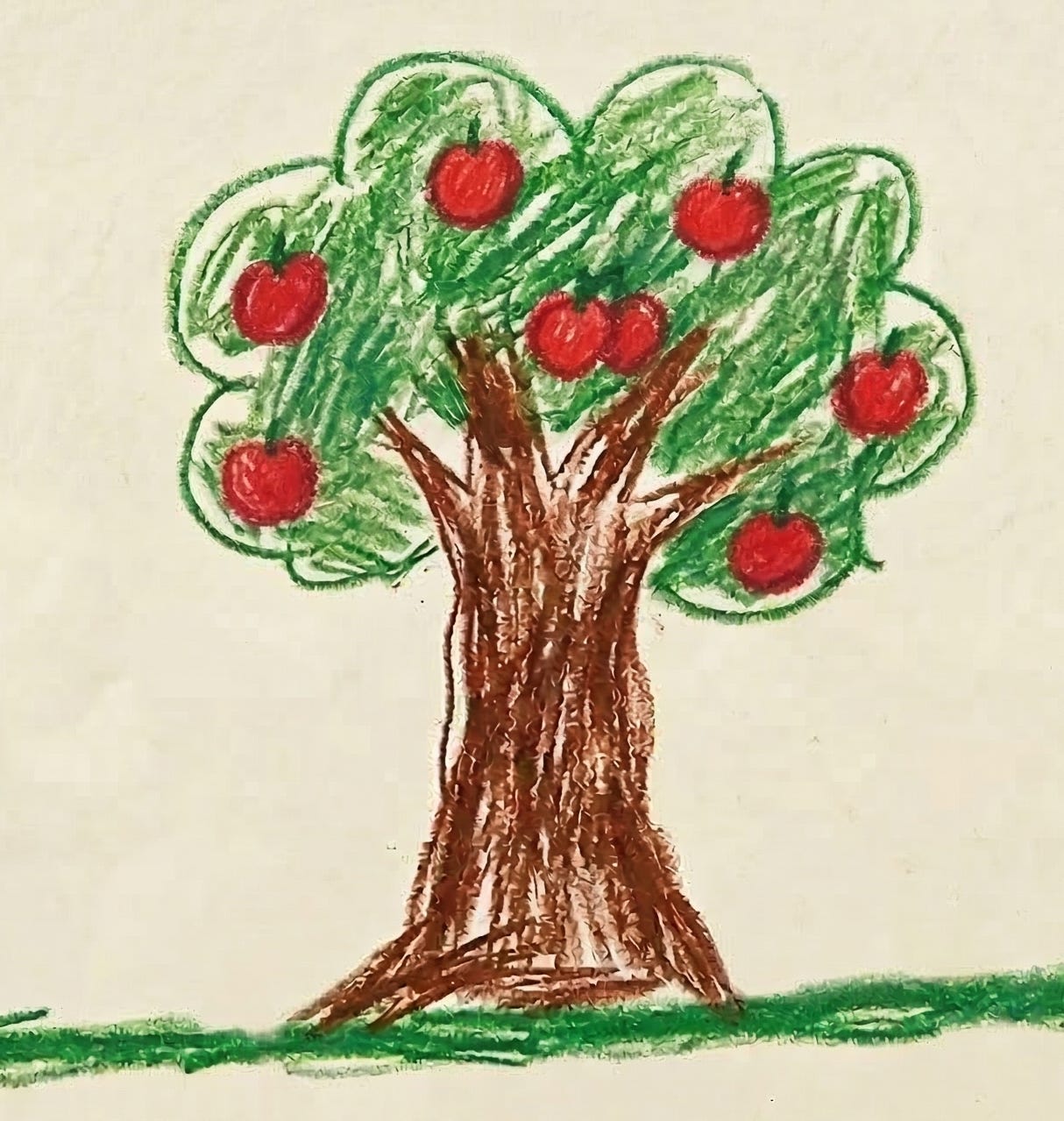
Notice that we’ve basically added elements and colors that set our tree apart from others, which tells us we’re now thinking from the world of categories. Finally, I want to invite you to imagine and draw a forest.
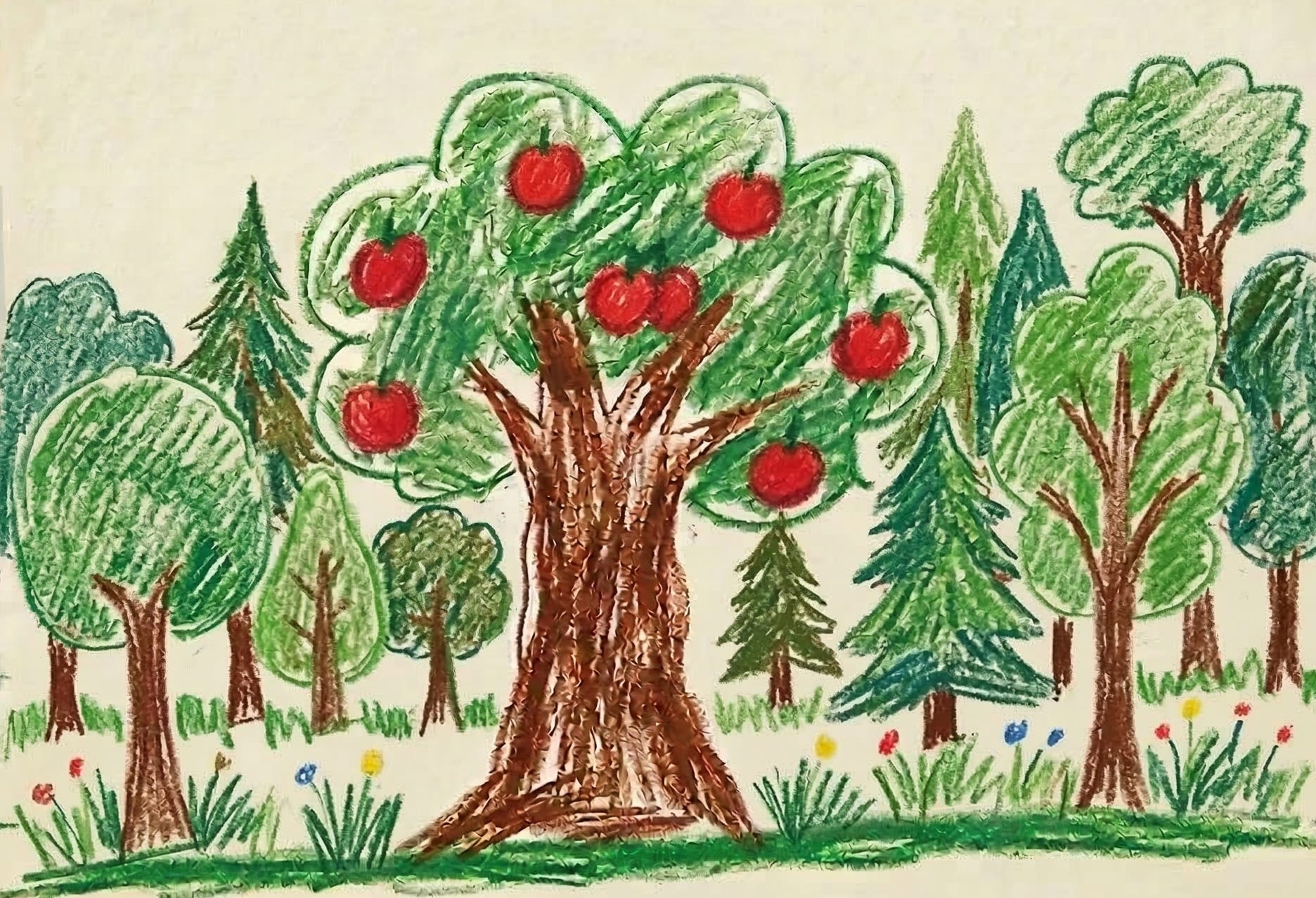
Once again, each of us will bring to mind an image of the forest built from our own experience and context. From the conceptual standpoint, our forest could contain every possible image of trees, according to our experience with the concept of a forest. Something fascinating happens here: the forest is no longer just a sum of trees, but a broader mental structure, a totality organized by context. When we reach that point, we’re brushing up against the conceptual as the sum of all possibilities; that’s why we struggle so much to understand the proof-of-concept work of costume designers, among others.
The idea of context is so powerful that it invites even deeper reflection. The broader my knowledge of forests, the broader the contexts I can recreate, so concepts like cloud forest, rainforest and tropical jungle could be explained without difficulty, and the differences between them (ideas) can be extracted with great ease, to the point where we could argue why a wet jungle isn’t a tropical forest, or why two landscapes that to an uninformed observer might look identical actually answer to completely different ecological, symbolic and material logics. To think conceptually is, in large measure, to widen the field of possible contexts.
Here the comparison with AI shows up again. An artificial intelligence can process an immense quantity of examples of trees, forests, jungles and mountains. It can classify millions of images, learn regularities, segment attributes, label shapes and produce surprisingly accurate descriptions. But its relationship with context is not lived; it’s calculated. It doesn’t inhabit the forest, doesn’t fear the jungle, doesn’t remember a walk in the rain, doesn’t associate the smell of wet earth with childhood or the rustle of leaves with an intimate experience. It can reconstruct the pattern, but it can’t inhabit the symbolic world that gives the pattern its dimension. That’s crucial for understanding the limits of computational intelligence: we humans don’t just process information, we live it inside a fabric of culture and meaning.
Steve Jobs became even more famous for a speech in which he told his audience that there was nothing brilliant about his work and that all he did was “connect the dots.” But what exactly did Jobs mean when he talked about connecting the dots? The answer is simple, but its depth is immense: the more you learn about a subject (the dots), the greater your capacity to widen your knowledge and question it, so as to simultaneously extract the differences (ideas) and, in this way, connect them around a need (vulnerability). This process is what we call creativity. Creativity, then, is not a magic spark fallen from the sky nor a privilege reserved for a caste of the enlightened; it’s the capacity to relate contexts, to build bridges between domains, to discover fertile differences where others see only scattered information.
It’s worth saying something important here: today we tend to overvalue the speed with which artificial intelligence connects dots, but we forget that not every connected dot produces meaning. A machine can link concepts with astonishing efficiency, but human creativity doesn’t consist solely of connecting; it consists of knowing why to connect, from where to connect and what for. In other words, the human doesn’t just assemble relationships; the human introduces direction, relevance, desire, anguish, intuition and meaning. The machine can suggest combinations; human consciousness decides which ones deserve to become meaning.
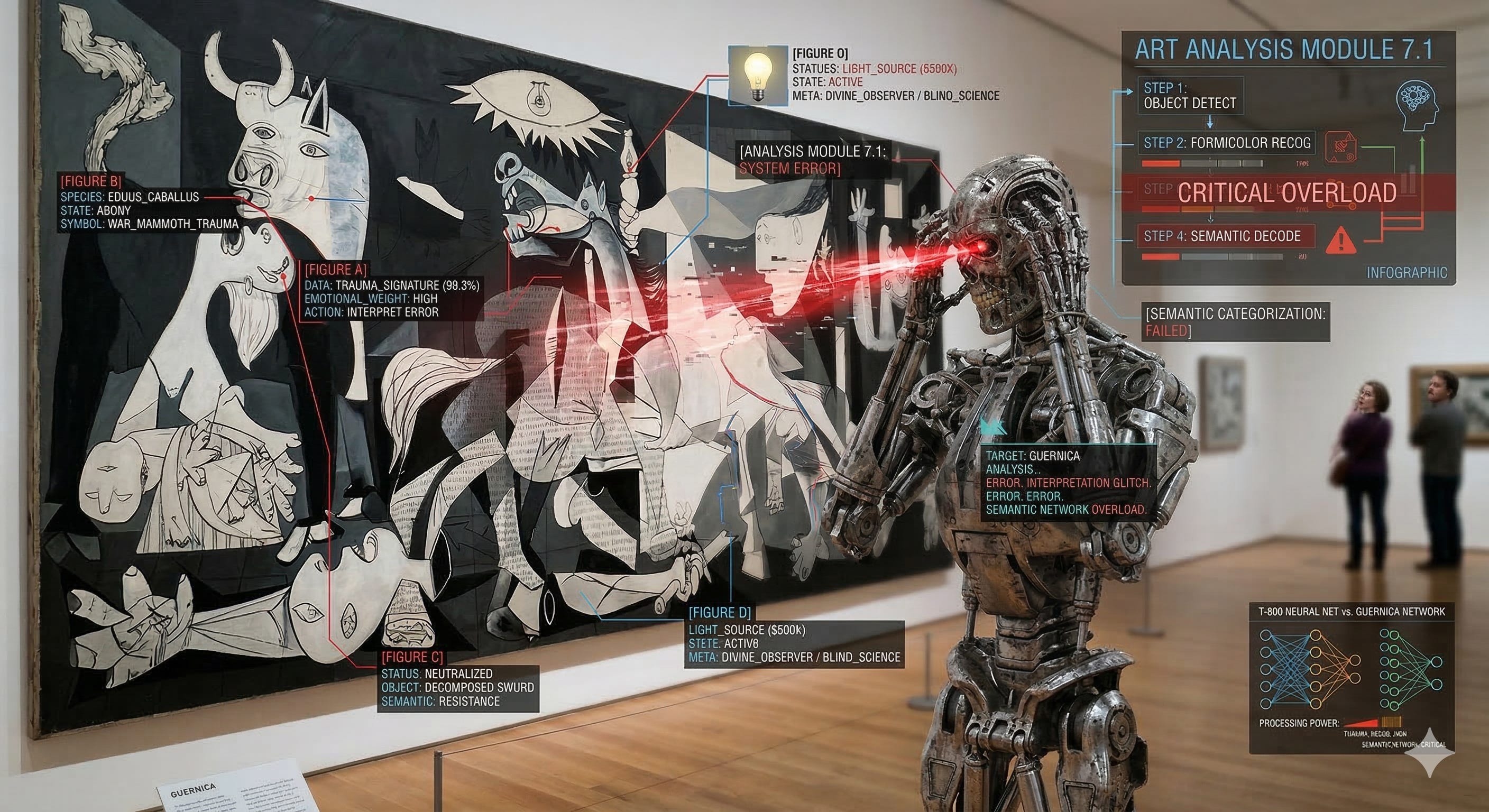
And what about intelligence?
Let’s go back to the Batesonian examples. This man argued that the human brain thinks in images; that is, we process images more easily than text. Advertisers and designers know this all too well: a brain that thinks in images processes more information thanks to a biological premise; the optic nerve transmits data to our brain at a speed and processing density that make the image a privileged pathway for organizing experience. Let’s do a new exercise. If I tell you to think of your friend John… take a few seconds before continuing. What will happen in your mind is that it will start scanning its internal database of images of every friend you have named John. We’ll watch the images go by, identifying the distinctive features of each one. What probably comes next is that many of you will say: John, which John?
So I’ll answer: John, the one who looks like James. Again the scan of your image database will kick in, in which you’ll surely contrast the images of the Johns in your memory with those of the Jameses, to extract the differences (ideas) and finally conclude whether they look alike or not. Conclusion: an idea is the image of a difference.
What seems so simple actually describes a deeply sophisticated mechanism. Our brain doesn’t think like a linear list of data, but like a web of associations, contrasts and activations. We think by comparing, filtering, associating, discarding, trying again.
Fine, but this still doesn’t fully explain what intelligence is. To find answers we have to bring in another genius of anthropology and linguistics: Ferdinand de Saussure. This linguist coined what we know today as the theory of the value of the sign, which explains the relationship between the signified and the signifier, or between what a thing denotes and what it connotes. We have an expression that sums it up simply and without so much fuss: what the donkey says is one thing, what the driver behind it says is another. I love that saying because, in its apparent crudeness, it holds an extraordinary semiotic truth: things don’t mean anything by themselves; they mean within a relational system.
Culture, as the operating system for humans, dictates the rules of what actions, objects, life experiences, rituals and bonds mean to us. A plate of beans has one symbolic dimension across the Americas and another in the islands of the Japanese archipelago. It’s the same bean, yes, but while in the Americas beans accompany a primarily savory meal, in Japan they can be filling for sweet pastries. The object is the same; the symbolic dimension is different. That symbolic difference isn’t decorative or anecdotal; it’s precisely what turns a simple material object into a cultural unit charged with meaning.
I don’t buy this business of IQs (Intelligence Quotients) as absolute indicators of human intelligence; to me the matter is quite relative. What I do believe is that there are people with far broader contexts of information, which let them generate more neural connections, more fertile associations, more capacity for reading across domains. Let me explain myself. Imagine a person with a very high IQ who, through one of life’s twists, is abandoned deep in the Amazon jungle. What do you think that person’s odds of survival will be in a place they have no context for? They’ll probably use every tool of their knowledge to try to survive. Now, on the other side there’s a member of a nomadic Indigenous community of the Amazon, with a probably lower IQ against the reference subjects by which such things are measured. Who will have a better shot at surviving in that place? Before moving on, I want to clarify that I’m not underestimating our Indigenous person; it’s merely a comparison to illustrate the concept, since the same thing could happen in reverse, and I’m almost certain our Indigenous person would have an easier time of it in a metropolis than a genius in the middle of the bush.
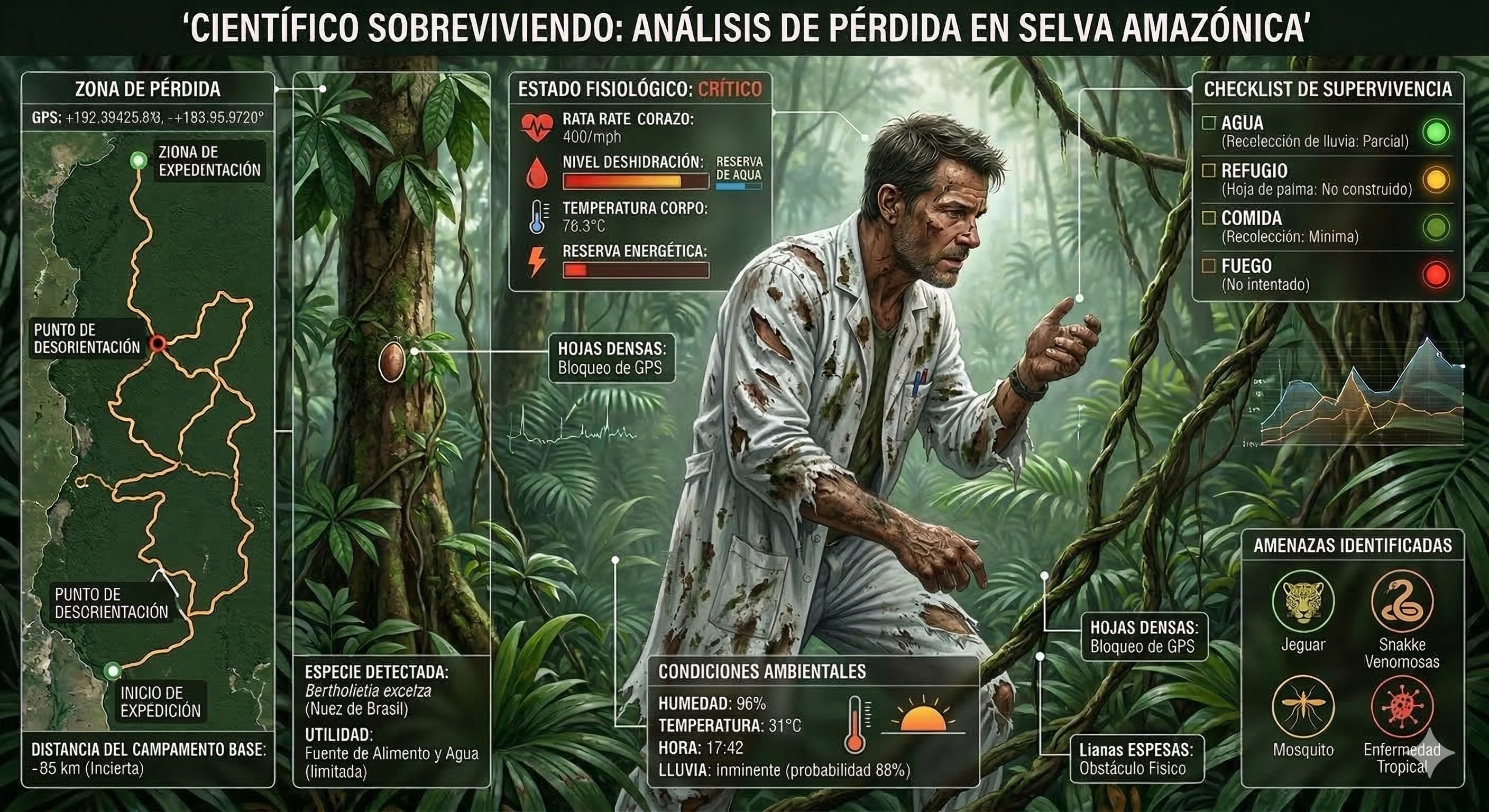
Intelligence, then, can be understood as the capacity we humans have to connect dots between different domains and contexts, both within a single symbolic domain and across others. In other words, the speed, depth and plasticity we have for connecting biology with astrophysics, robotics with anthropology, design with survival, memory with invention, so as to extract the differences and build networks of meaning.
The difference between human intelligence and computational intelligence is that we build the former out of networks of meaning, while the latter is built through mathematical algorithms devoid of any symbolic content of their own and of lived experiences. To an artificial intelligence, it makes no difference whether you’re writing a romantic poem or a formula to reinvent Coca-Cola, because in both cases it’s processing correlations, regularities and probabilities within a mathematical field. The machine processes; the human interprets. The machine correlates; the human seeks meaning.
This difference is no small thing. An AI can recognize a poem’s style, imitate its meter, produce an emotive verbal structure and even simulate delicacy or melancholy, but it doesn’t know what it is to love, to lose, to wait, to grow old, to fail or to remember. It has no biography, because it has never been wounded, has never felt the urgency of time, nor shame, nor grief, nor desire. Its intelligence, however powerful, lacks the existential pressure that gives density to human experience. Without that density, what you have is a hollow intelligence, formidable at operating, but not necessarily intelligent at understanding in the anthropological sense of the word.
What role does vulnerability play in all this mess?
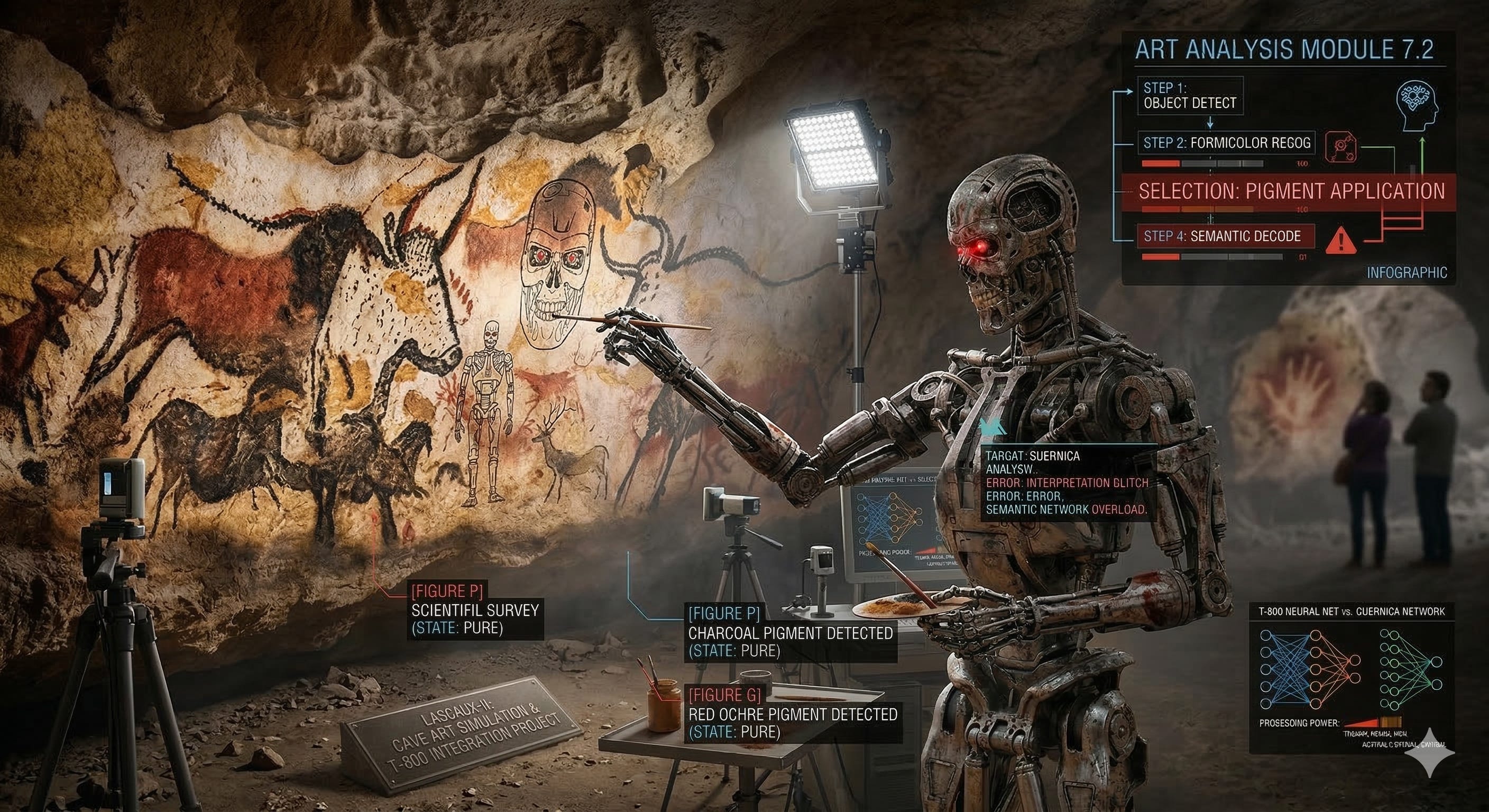
Since time immemorial, when we painted the cave walls, forged arrowheads as tools for hunting big game or gathered seeds on the floodplains, vulnerability has been the mother of creativity. No one can dispute that creativity switches on when we’ve got the predator breathing down our neck. Postwar Germany wouldn’t be what it is today were it not for the tremendous vulnerability its population was left in after WWII, and the same goes for Japan. The thing is, nowadays we prefer to call vulnerability unmet consumer needs. Maslow wrote a whole treatise on the subject; I’m not going to get into that debate, I just want to say that vulnerabilities are the active spectrum of creativity, and that depending on the level of those vulnerabilities, so too will be our response.
Here I want to insist on something I find central: human creativity is not born of comfort, it’s born of friction. It’s born of the fragile body, of scarcity, of need, of fear, of curiosity, of the discomfort of not understanding, of the pain of falling short, of the pressure to solve. The wheel, the needle, the city, medicine, myth, agriculture, philosophy and even art can be read, to some degree, as creative responses to human vulnerability. We don’t invent for the fun of it; we invent because something is missing, because something threatens us, because something calls to us, because something hurts us. Here again an enormous border with AI appears. The machine doesn’t know vulnerability, doesn’t feel hunger, doesn’t fear death, doesn’t need shelter, doesn’t fall in love, doesn’t grow old, doesn’t seek transcendence. It can optimize solutions, but it doesn’t suffer the problem. Between suffering a problem and processing it there’s a gigantic anthropological distance.
Necessarily, when we talk about creativity and human intelligence, we have to talk about our attitudes toward needs, and on that front I’ll say there are at least two perspectives. There are people who face needs with a jigsaw-puzzle mindset, connecting little pieces (ideas) one by one until the puzzle takes shape (meaning). But what happens when pieces are missing? This is where the challenges to creativity arise. Now, on the other side we have those who see problems like engine builders; that is, they connect dots (ideas) with which they seek to move forward, refusing to let the absence of a single part stop them. Along these lines, which kind of intelligence do you identify with more, the jigsaw-puzzle assembler or the engine builder?
I find this comparison powerful because it describes two very different cognitive dispositions toward the world. The puzzle assembler needs the final image, needs the exact piece, needs to close off the meaning. The engine builder, by contrast, is willing to improvise, to substitute, to reconfigure, to advance even when the map isn’t complete. One seeks completeness; the other seeks movement. One orients by the finished image; the other by the possibility of generating traction. If we think about it carefully, the age of AI is demanding of us more and more engine-builder intelligence and less jigsaw-puzzle intelligence, because the world coming won’t reward only those who know how to repeat a recipe, but those who know how to reconfigure domains, cross contexts and build meaning amid the abundance of automated information.
What we know as intelligence also has to do with the way our neural network operates (connecting the dots). There are those who live in attention mode, that is, constantly monitoring the information they consume, filtering out what adds value to their system of connections and eliminating the noise. Their information diet is policed rigorously. On another level are those who live in something neuroscience calls the DMN (Default Mode Network). No matter what they’re doing, their mind lives in constant connection training; rather than hunting for the missing piece, they seek to hack the default order to find new formulas or disruptions. Finally there’s scanner intelligence, the kind of intelligence permanently searching for signals, in order to detect them, amplify them, extract the differences (ideas) and add them to its symbolic domain. They live in permanent reinvention.
These three forms aren’t sealed compartments, but they do help us understand distinct styles of being in the world. The one who lives in attention mode filters. The one who lives in the DMN recombines. The one who lives in scanner mode detects weak signals before everyone else. If there’s anything I want to underline here, it’s that creativity doesn’t depend solely on having information, but on the way the mind works with that information. AI, for example, may look like an extraordinary scanner-mode machine, because it tracks patterns at brutal scales; it may also look like an inexhaustible recombination machine, because it articulates scattered elements with great speed. But it still lacks the thing that makes creativity truly human: the tension between the inner world and the outer world.
Computational intelligence and creativity
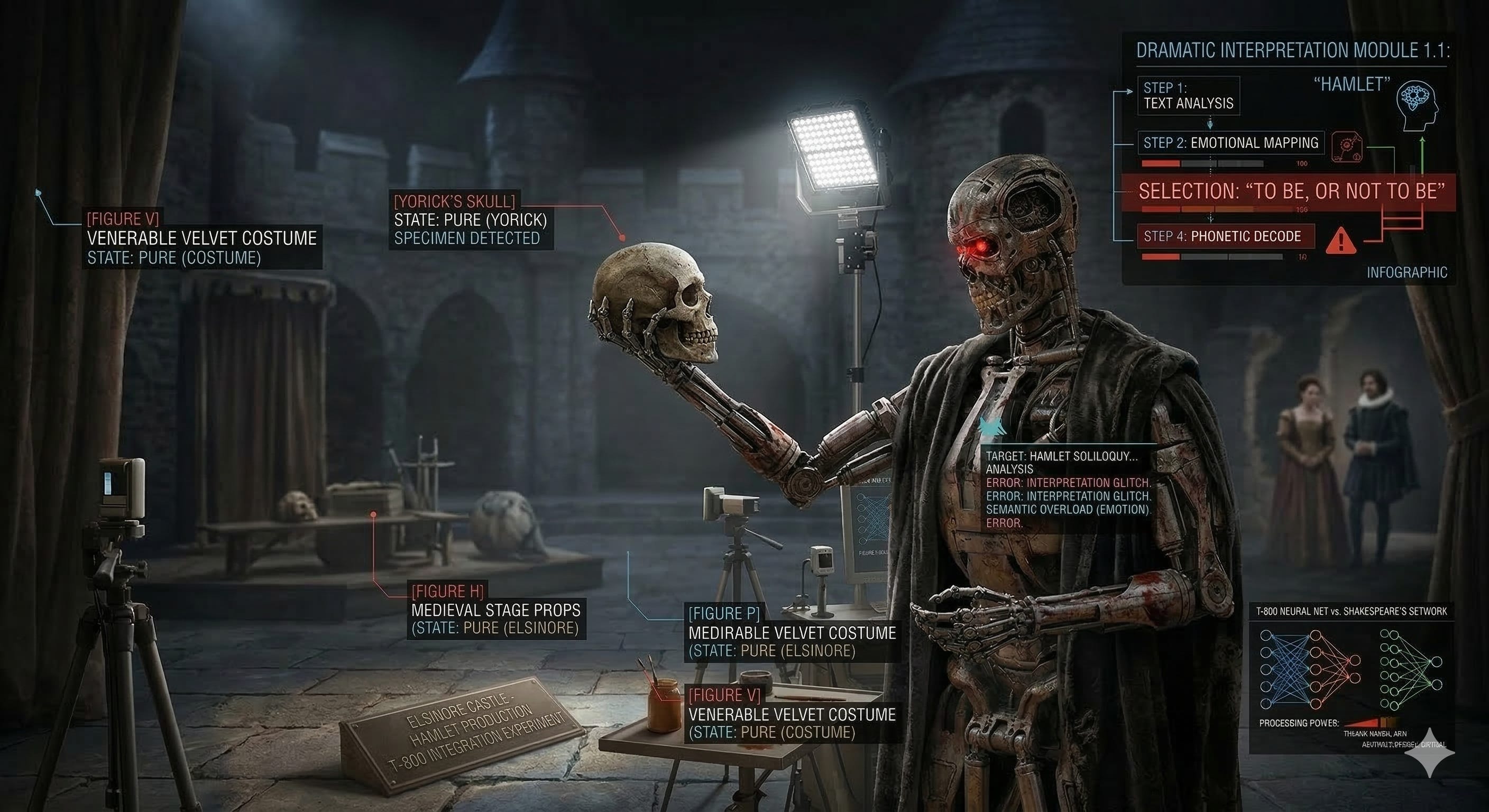
Whereas human intelligence and creativity require broad networks of context and symbolic content to develop, mediated by culture as a catalyst and accelerator of knowledge, computational intelligence and creativity lack the capacity to analyze content outside the symbolic field of whatever they’re processing. Their operating system is algorithmic, while for humans the operating system is governed by culture, which allows unlimited combinations of dots (ideas). Think of AI as a system whose OS is limited to a linear program within an exclusive field, or if you prefer, an LLM, whereas human intelligence can run transversally across all operating systems; it would be a multivectorial intelligence set against the specialized, statistical and bounded character of LLMs. It’s agnostic in operating-system terms.
I want to make an important clarification so I’m not misread. I’m not saying AI is small potatoes. Quite the opposite: I think it’s an extraordinary tool, probably one of the most powerful humanity has ever produced. What I’m saying is that its power isn’t equivalent to our form of consciousness. AI can help us explore possibilities, accelerate iterations, simulate scenarios, find improbable connections, push cognitive work toward speeds previously unthinkable. But that’s no reason to make the mistake of granting it a cultural sovereignty it doesn’t possess. The machine doesn’t generate culture on its own; it participates in culture through the human materials it was trained on and through the human uses we give it.
In other words, AI can produce content with astonishing power, but producing content is not the same as producing meaning. Meaning emerges when a human community interprets, argues over, adopts, rejects, ritualizes, transmits or transforms something within a cultural network. A poem doesn’t become important because it’s well written, but because it strikes a human chord and manages to insert itself into a symbolic economy. A theory doesn’t change the world just for being coherent, but because it reorganizes the way a society thinks about reality. A technology doesn’t matter just because it works, but because it alters habits, expectations, relationships and structures of power. That’s where the difference lies.
Now then, will we be replaced by AIs? As long as AIs don’t have the capacity to generate culture, we’re safe. When I say generate culture, I don’t mean mixing signs, styles or references, but the deepest part of the cultural process: building meaning out of experience, out of a vulnerability, out of a shared history, out of the experience of being alive within a human community. The machine can be a great mirror, a great amplifier, a great cognitive telescope; but the astronomer is still the human. It can help us traverse the territory, but it still can’t produce, on its own, the symbolic ground on which we walk.
The AI debate tends to close with a question that inevitably shows up in any contemporary conversation: will we be replaced? Deep down, this question reveals more about our cultural insecurities than about the true nature of intelligence. When we fear being replaced by a machine, we’re assuming that human intelligence and computational intelligence belong to the same order of phenomena. But across these pages we’ve seen that this isn’t so.
The truly interesting question isn’t how fast a machine can produce something, but what that something it produces means. Here a fundamental difference appears: whereas AI operates over statistical patterns within an algorithmic domain, human intelligence operates within a symbolic universe built by culture.
In other words, an AI can combine millions of texts to produce a poem that’s perfect from a formal standpoint, but it doesn’t possess the cultural fabric that lets it understand what love, loss or nostalgia mean within human experience. It can recognize the structure of a metaphor, but it doesn’t inhabit the world where that metaphor acquires meaning. AI calculates; human intelligence interprets.
If we recall the Batesonian definition of an idea as a difference, we can see this point more clearly. An artificial intelligence can detect statistical differences between patterns of data, but those differences have no cultural meaning for it. They’re simply mathematical variations within a vector space. For humans, by contrast, differences don’t just exist; they mean something. They get inserted into symbolic networks, into stories, into emotions, into cultural contexts that transform a mere difference into an idea charged with meaning.
That’s why, when we talk about human creativity, we’re not simply talking about producing something new. We’re talking about reconfiguring networks of meaning within a cultural system. A technological invention, a scientific theory or a work of art doesn’t just introduce novelty; it reorganizes the way a society understands the world. That’s the true creative act.
AI, by contrast, operates within a system we could describe as a space of probability without experience. It can generate millions of possible combinations within a semantic field, but it lacks the thing that feeds human creativity from its deepest roots: lived experience, vulnerability, history, cultural memory.
Let’s recall that above we affirmed that vulnerability has always been the mother of creativity. Tools were born because humans were physically weak against predators. Cities were born because cooperation increased our chances of survival. Science was born because we wanted to understand natural forces that overwhelmed us. Even art, in many senses, was born as an attempt to tame the fear and mystery of existence.
Human creativity, therefore, doesn’t arise from an abundance of information but from the friction between our limitations and our aspirations. It arises when something hurts us, when something is missing, when the world doesn’t quite fit our expectations. The machine, by contrast, knows no vulnerability. It feels no hunger, no fear, no existential curiosity. Without experience, there’s no culture.
For this reason, when many announce the end of human creativity in the face of AI’s advance, they’re actually confusing two radically different things: content generation and the creation of meaning.
Culture is a living system that emerges from the interaction of millions of human minds interpreting the world from different perspectives. It’s a symbolic system that evolves across generations. AI can participate in that system as a tool, as an amplifier, as a catalyst even, but it can’t substitute for the cultural process that produces it.
In a sense, we could say AI functions as a cognitive telescope. It expands our capacity to explore possible combinations within existing knowledge. But just as a telescope doesn’t replace the astronomer, artificial intelligence doesn’t replace the thinker. What it does is expand the horizon from which we think.
If anything characterizes our species, it’s precisely that capacity to extend our faculties through tools. Fire amplified our capacity to transform nature. Writing amplified our collective memory. The printing press amplified the circulation of knowledge. The computer amplified the processing of information. AI amplifies our capacity to explore the space of ideas.
The right question isn’t whether AI will replace human creativity. The right question is what kind of creativity will emerge when we live alongside intelligences capable of processing information at inhuman speeds. What new forms of thought will appear when massive computation stops being a scarce privilege and becomes everyday infrastructure? What kind of authors, scientists, designers, storytellers or strategists will emerge when thinking no longer means doing it all alone, but knowing how to converse with systems capable of brutally expanding the field of possibilities?
Because every time humanity has created a powerful tool, human creativity hasn’t vanished. It has changed form. Let me ask you: did painters disappear with the rise of photography? What we’re witnessing now isn’t the end of human creativity, but an expansion of its territory.
AI will be able to help us explore combinations of ideas that would once have taken decades of work. It will be able to suggest unexpected connections between distinct domains of knowledge. It will be able to accelerate processes of research, design or discovery. But the decision about which problems are worth solving, which questions are worth asking or which meanings we want to build as a society will remain a deeply human decision.
Because at the end of the day, machines can process information, but only we humans live the stories.
That’s why, if there’s any conclusion to draw from this reflection, it’s that human creativity is not threatened by AI. What is threatened, in any case, is our intellectual laziness. The ease with which we can outsource thinking to automatic systems. The temptation to consume ideas instead of building them. The risk of turning a tool for cognitive expansion into a crutch for the imagination.
Artificial intelligence will be as powerful as the culture that uses it. If we use it to repeat what we already know, it will become a gigantic echo machine. But if we use it to explore the unknown, to connect distant domains, to widen our collective imagination, then it will become one of the most extraordinary tools humanity has ever created.
Ultimately, the future of creativity doesn’t depend on artificial intelligence. It depends on our will to stay curious. On our capacity to keep widening our contexts, to keep connecting dots between seemingly unrelated domains, to keep asking ourselves why the world is the way it is and how it could be different.
DISCLAIMER
This document is for informational, educational and futurist-analysis purposes only. It does not constitute financial advice, nor a solicitation to invest, nor a recommendation to buy, sell or participate in any instrument, company, project or asset.
If anyone uses the content of this material to solicit money, investments or economic participation, treat it immediately as a possible scam.
Always protect your personal and financial information.