

Welcome to a new conversation. Today I want to tackle a topic that’s trending: “Context Engineering” as the centerpiece for building agentic AI architectures. Before I plunge into the deep end, let me give the context some context.
Most people who know me know I’m an anthropologist and a designer; those two disciplines are my great loves. What few people know is that before I ever set foot in anthropology, I studied Civil Engineering and Construction. And honestly, it’s not that I struggled there; I’ve always liked math, physics especially. But back in my engineering student days, the courses I loved most were the ones tied to the social sciences. Part of our training as engineers included a few courses in the history of construction, which were really just seminars in the history of architecture. In those classrooms I discovered that what truly fascinated me was form, design, and how human societies have interacted with it across history. Those experiences quietly laid the path that would connect anthropology and design.
During my early years as an anthropologist in training, I started my working life writing the training and service manuals for a well-known dial-up internet provider (back when you needed a phone line to get online, something the younger crowd will never quite grasp). From the hard chair of a call-center operator, I took my first steps toward understanding how much context matters in the world of technology. I caught so many earfuls of profanity from deeply pissed-off customers that many of those voices still echo in my memory. I owe all of them what I’ve built (thank you, sincerely).
So there, somewhere between training manuals, quality control, and customer service, I managed to fuse engineering, anthropology, and design. That blend let me translate customer needs into engineering requirements, and then turn those into better user experiences. And you know what? Over more than 25 years of professional experience, I’ve come to one conclusion: the key to solving most business problems has always lived in a perfect understanding of context. The angry customer of yesterday and the AI agent that hallucinates today are symptoms of the same disease: nobody took the trouble to map the context in detail.
That’s why understanding it is a critical success factor in the development of any product or experience, whether we’re talking clothing, medical services, banking, transportation, web apps, transactional platforms, you name it. And when it comes to AI, robots, agents, LLMs, once again context is king.
There’s a lot of talk today about “Context Engineering.” It’s an ambitious term, mostly because it sells. Slap the word “engineering” on anything and people instantly associate it with the hard sciences. But the truth is that context is more anthropology, sociology, psychology, and philosophy than it is engineering. I deeply respect the dissenting view, but context is less source code and more meaning. You can sit there and spew out all the code you want, but in the end, if that code doesn’t turn into meaning that drives adoption, it’s just more machine learning. For adoption to go mass-market, it has to leave the world of zeros and ones and enter the world of the social, and that only happens when adoption starts talking in street slang.
Context from First Principles
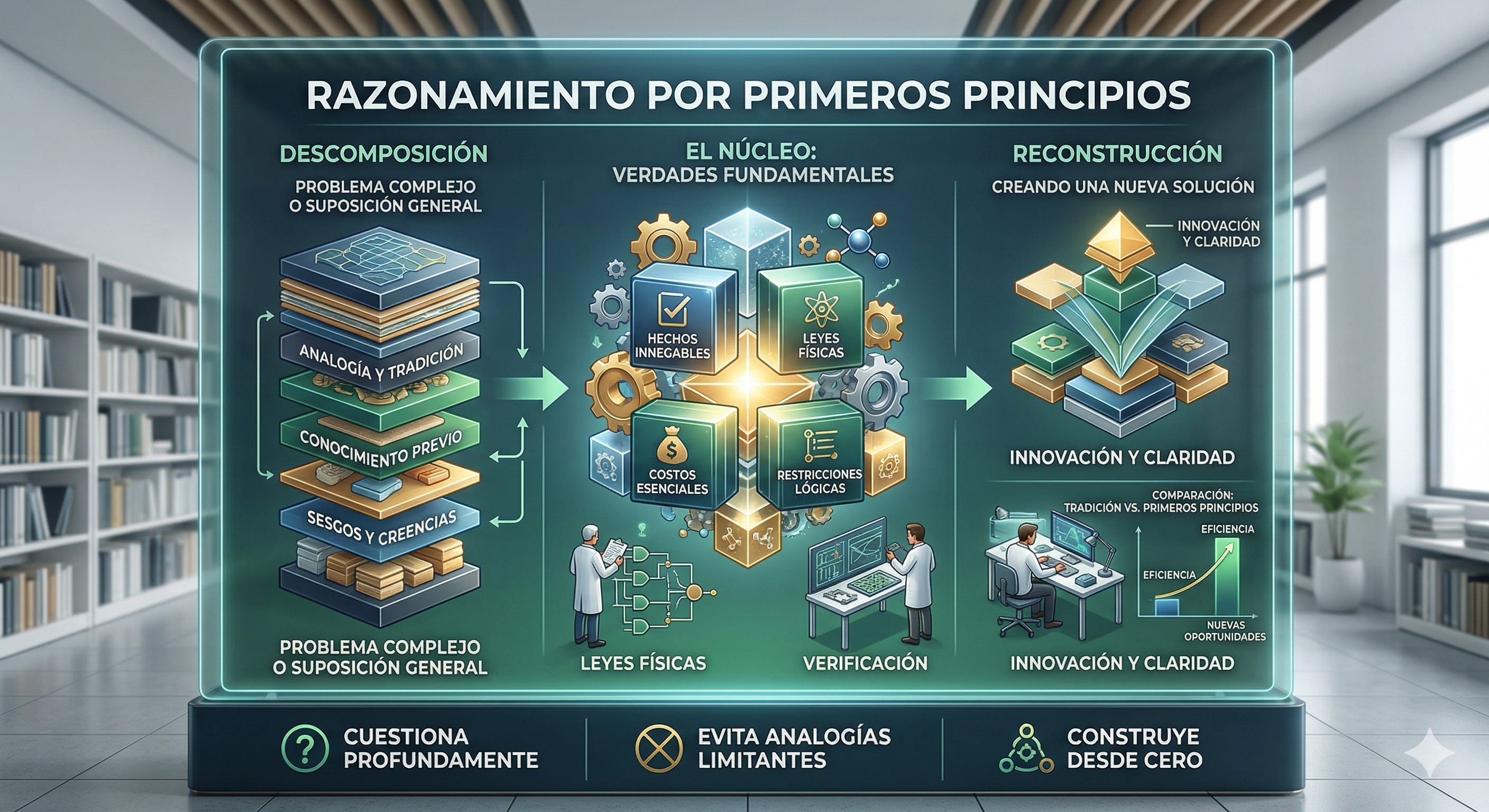
Thinking from first principles, context can be understood as the structured set of relationships that give meaning to an action, a signal, a behavior, or a decision. Many people wrongly assume that context is strictly tied to the environment in which things happen, but the truth is that beyond being a conceptual space, context is the interpretive field that makes understanding possible.
The word context comes from the Latin contexere, or “to weave together.” That’s why context can’t be thought of as something static; it’s a system of historical, cultural, economic, symbolic, relational, and temporal variables.
To define it rigorously, context is “the dynamic configuration of the conditions, relationships, and meanings that shape a perception, an interpretation, and an action.”
Seen through a systems lens, context operates as a filter (it decides what’s visible and what’s invisible), a constraint (what’s possible and what isn’t), a frame (what carries meaning and what doesn’t), and a force field (which behaviors get rewarded and which get punished).
Max McKeown captures this when he says that context determines how a strategic issue fits into “a broader pattern of leadership in the situations we’ve been working through in pursuit of success.” In other words, strategy can’t exist independently of context; it’s embedded in it. McKeown nails the executive dimension of context, but as we’ll see, that’s just one of its many layers.
The Anthropological Lens
We anthropologists don’t see context as backdrop. For us, context is the primary object of analysis in our profession. We know that human behavior can’t be understood in isolation, as if we were studying it inside a lab. Context has to be interpreted through symbolic systems, cultural codes, and social structures. This is exactly where the “context engineers” fall short: their mistake isn’t technical, it’s a failure of depth. They model the surface and call it architecture.
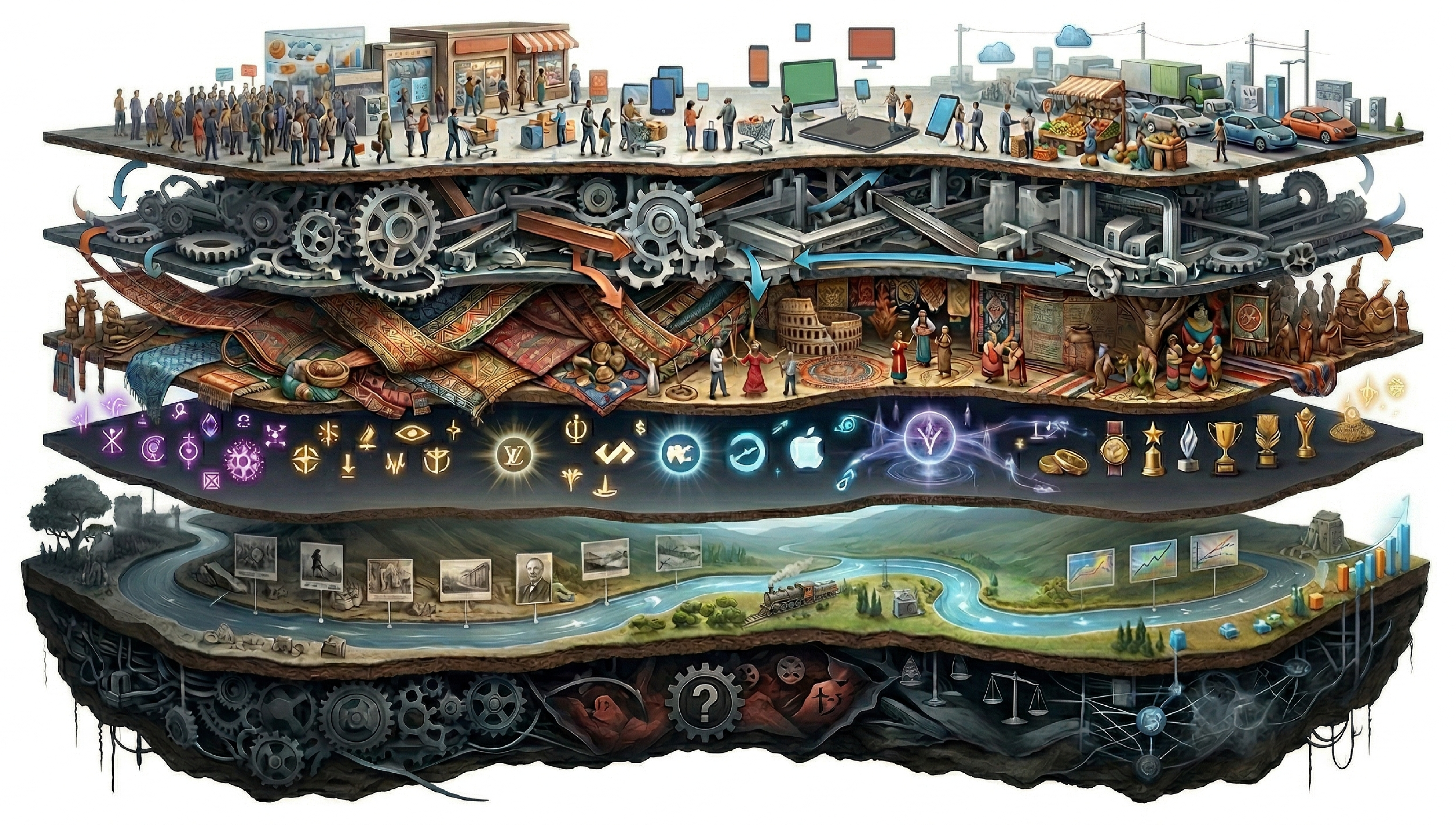
For anthropologists, context is a system of multi-vector layers, where each layer is itself another system. All of these layers are cultural in nature: economic, political, religious, technological systems, and so on. It’s more like a giant onion whose layers you peel back until you reach the core. Don’t confuse these cultural layers with the operational mapping layers we’ll get to later; both describe the same phenomenon but from different levels of analysis: one to understand it, the other to design it.
Clifford Geertz, one of the most influential anthropologists of the 20th century, defines culture as a vast web of meaning spun by human beings; context, in this sense, is the web. A wink and a blink are physically identical, yet we all know they’re not the same thing.
The Strategic Lens
If anthropology explains how meaning is built out of context, strategy explains how competitive advantages are built. From this angle, all strategy is contextual by definition. Jo Whitehead defines strategy as a quantum entity: it’s both objective and process, all happening at once. But the process can only exist in relation to context, that is... market conditions, the competitive frame, the organization’s internal capabilities, and so on.
Without context, strategy is just a form of abstraction. This is the second weakness of the “context engineers”: it’s not only that their contexts are abstract, it’s that they routinely ignore the power structures and market dynamics that condition every decision.
I’m fond of the concepts laid out by Michael Porter. Plenty of people call him a dinosaur, but I think much of his work still holds up, especially his model for mapping contexts, known as the five forces: competitive rivalry, the bargaining power of suppliers, the bargaining power of buyers, substitute products, and barriers to entry. These define the economic structure of a context.
Now, other experts like Mintzberg, Godin, and McGrath show up a little late to the party when they define context as an invisible, non-static system that co-evolves and persists, and therefore it’s strategy that must do the same (I say late because the anthropology classics had already worked this out).
In the world of tech systems, context includes rapid technological shifts, very short product life cycles, and accelerated competitive innovation dynamics. In short, in tech context is far too volatile, and it compresses in time on top of that, AI is certainly giving us proof of that.
Mapping the Context
How are we doing so far? Tired of all the theory? Take a deep breath, we’re almost at the good part. We’re about to step into the topic that brought us here: how do you map a context in order to build experiences? Because despite AI’s apparent novelty, agents are, in essence, experiences, and every experience can be mapped.
Before I walk you through how to map a context, let me remind you that we anthropologists think in “frameworks.” Apologies in advance for the anglicism, but honestly I’ve never found the word in Spanish that captures everything a framework-based mode of thinking represents. If you read my last Substack, you’ll easily get that thinking in frameworks is basically a conceptual mode of thought where all possibilities are possible.
In essence, context mapping is basically systems mapping. Methodologically, it helps to think of systems as if they were made of layers and levels of interaction (philosophically it gets a bit more complicated, but we’re not here to tie ourselves in knots). It’s worth stressing that no two systems are alike and that every system has its own specifics.
One important skill we anthropologists are trained for is pattern recognition. We’re always on the hunt for those recurring elements that let us make the system visible. What is it that repeats? Which patterns trace out a behavior? This is Layer #1 of context: observable reality, or surface structure.
I’ve watched plenty of “context engineers” jump straight to design, skipping contextual discovery entirely. The result is agents that produce hallucinations and serve up barely relevant information. Conclusion: agents that manufacture frustration. I know the path I’m proposing is longer than what most sources push on social media, but I guarantee you, with absolute certainty, that this model is “free of hallucinations and frustrations.”
So take my advice and, as the Supertramp song goes... “take the long way home.”
Let’s keep going. Write down everything you know about observable reality, leaning on market data, consumer behavior, trends, signals, and so on. Then move to identifying the structural context, Layer #2: which market forces hit it, what the economic constraints are, the power dynamics, the cost and pricing structures, and so forth. Then move toward Layer #3, the cultural context. This one is made of beliefs, social norms, narratives, and identity mechanisms. The next layer is symbolic context, Layer #4, composed of meaning systems, brand perceptions, and status signals. Layer #5 is temporal context; ask yourself what your project’s historical trajectory is and what its future expectations are. Finally, Layer #6 is hidden context; ask yourself which factors are actually driving the market, what its fear structures are, and what asymmetries are present, what’s invisible but decisive.
I know this sounds a bit overwhelming, and I’m certain you’re wondering, do I have to do all of that just to program a personal AI agent? My answer is NO. But the quality of the experience you want to create will depend on how much rigor you put into your context discovery.
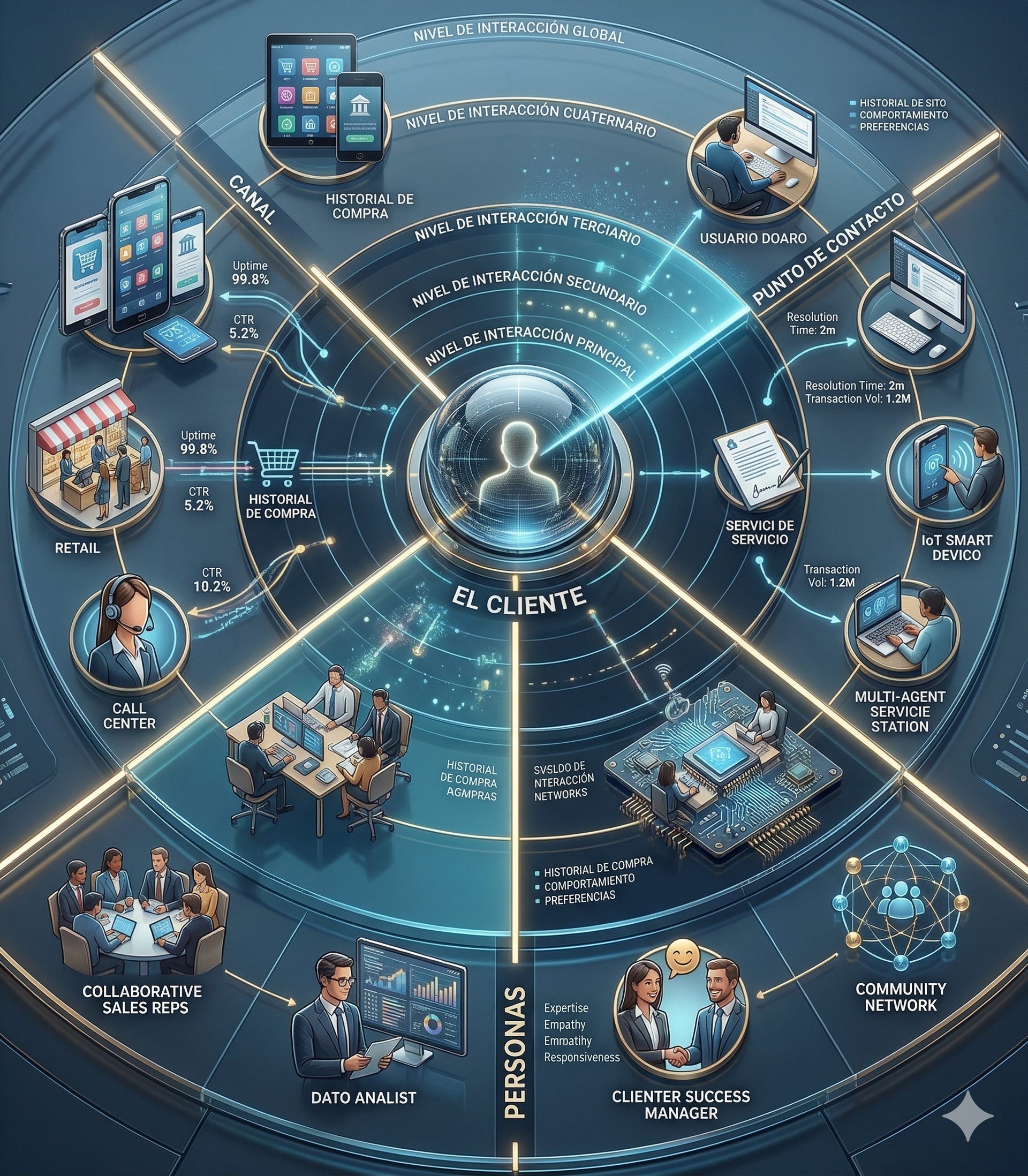
Once you’ve done solid context research, the next step is to visualize it. I suggest you map the context as if it were a radar: at the center you must always place the person who consumes the experience, it could be you, it could be a customer. That center isn’t decorative, it’s the system’s center of gravity; everything you draw around it must relate to it, directly or indirectly.
Then start tracing circles around the center. These will be the interaction levels of your experience. Think of these circles as layers of proximity: the closest circle represents the most direct, immediate, and frequent interactions, while as you move away from the center you start to find more indirect, more sporadic, or even invisible interactions, invisible to the user but no less important for it. They can be clicks, decisions, moments of use, moments of friction, moments of abandonment, moments of discovery. Every experience is different, so draw as many levels as you think you need. There’s no correct number, there’s an appropriate depth.
Now, each of those circles has to be read in three dimensions, and this is where the map stops being a drawing and starts being a system. Divide your radar into three sectors and name each one: Touchpoints, Channels, and People.
The Touchpoint is the moment of truth. It’s the specific event where the interaction happens. It’s where the system materializes in front of the user. It can be a click, a call, a conversation, a notification, a delivery, a recommendation. It’s precise, it’s concrete, it’s measurable. If you can’t point to it, it’s not a touchpoint. At this level you have to ask yourself: what exactly is happening here? What does the user expect? What do they actually get? Where does the friction show up? Where is value created?
The Channel is the infrastructure that makes that touchpoint possible. It’s the medium through which the interaction occurs. It can be an app, a call center, a physical store, a chatbot, an email, an API. It’s the pipe the experience flows through. Very often design errors aren’t in the touchpoint but in the channel: latencies, friction, badly resolved interfaces, disconnections between systems. Here the question isn’t what happens, but where and under what conditions it happens.
People are everyone who interacts with the system, but not just as functional users, rather as contextual beings. This is where everything you already mapped comes into play: beliefs, expectations, fears, motivations, cultural context, socioeconomic level, life stage. The same experience changes radically depending on who lives it. That’s why, at this level, you have to ask: who is this person at this specific moment? Not in the abstract, but in situation.
When you map these three dimensions, Touchpoint, Channel, and People, you’ll start to see the patterns, you’ll start to identify where the system is aligned and where it breaks. Where there’s coherence and where there’s noise. Where context is being respected and where it’s being ignored. This is exactly where the real value of the exercise shows up: not in the map as an artifact, but in the ability to intervene. Because once you can see the system, you can redesign it, you can strip out friction, reinforce moments of value, adjust channels, reconfigure interactions. In essence, you can align the experience with the context.
Mapping context this way isn’t an aesthetic exercise, it’s a precision instrument. It’s what separates an agent that responds from one that truly understands.
From Context Maps to AI Systems
This is the point where the synthesis reaches its real transformative potential. Most artificial intelligence systems fail not from a lack of data, but from a deeper deficiency: the absence of contextual understanding. They process huge volumes of information, but without a framework that grants meaning, which inevitably leads to superficial results and decisions misaligned with operational or strategic reality.
That’s why AI shouldn’t be conceived as a system trained solely on data, but as an architecture trained on contextual structures. This means incorporating relationships, hierarchies, and meaning systems that let it interpret information beyond its raw form. In this sense, context maps become genuine design blueprints: they function as an operating system for intelligent agents, defining not only the inputs, signals, metadata, and relationships, but also the interpretation layers grounded in cultural rules and strategic logic, and finally the decision layer, where context-aligned responses are generated.
A clear example of this difference shows up in an AI-based sales agent. Without a well-structured context, the system would recommend products randomly or generically. But operating on top of a context map, the agent understands the customer’s life cycle, the industry’s dynamics, the buying signals, and the cultural codes that shape the decision. The result is a highly relevant action, with a higher probability of conversion and strategic coherence.
To reach this level of sophistication, AI training has to be structured across multiple layers of context. First, the data context, made up of structured datasets. Second, the relational context, which defines the interaction networks between actors. Third, the behavioral context, which captures patterns of action. On top of that comes the strategic context, which incorporates objectives and constraints, and finally the cultural context, which integrates language, tone, and social norms. Only by integrating these layers can you build truly intelligent systems.
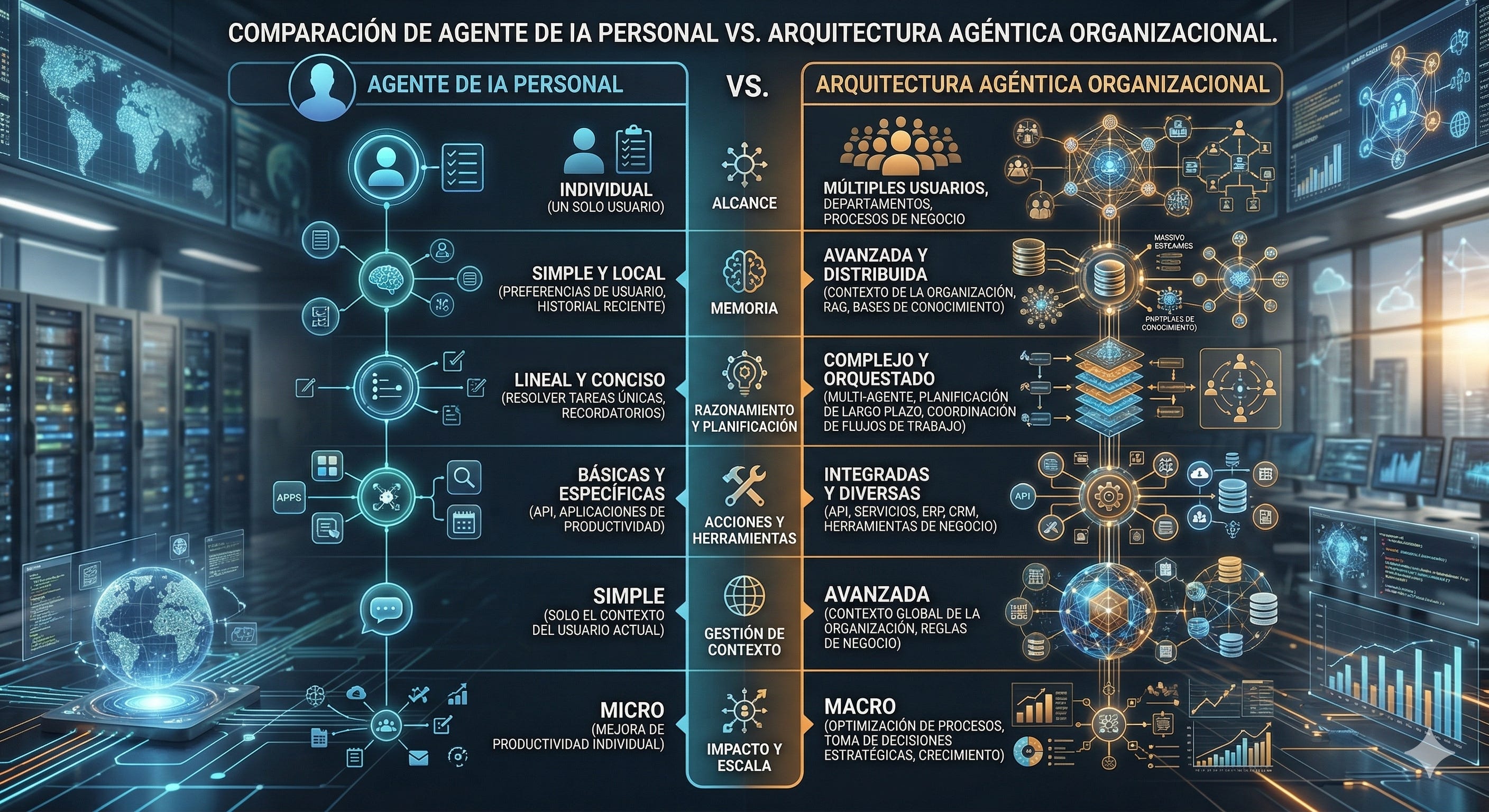
Designing a personal AI agent is one thing; orchestrating an agentic architecture that operates across an organization’s processes is another. Although they seem essentially the same, scale matters when it comes to mapping contexts.
Context shouldn’t be understood as a passive background, nor as a mere environment, and least of all as a set of isolated data points. Context is, in truth, the invisible architecture of reality. It’s the system that organizes what’s possible, what’s visible, and what’s meaningful.
Anthropology teaches us that context creates meaning. Strategy shows us that context creates advantage. And artificial intelligence forces us to recognize that context must be modeled explicitly to generate true intelligence.

DISCLAIMER
This document is for strictly informational, educational, and futurist-analysis purposes. It does not constitute financial advice, an investment solicitation, or a recommendation to buy, sell, or participate in any instrument, company, project, or asset.
If anyone uses the content of this material to solicit money, investments, or financial participation, treat it immediately as a possible scam.
Always protect your personal and financial information.